Abstract
Previous studies have reported that PID2, which encodes a B-lectin receptor-like kinase, is a key gene in the resistance of rice to Magnaporthe oryzae strain ZB15. However, the PID2-mediated downstream signalling events remain largely unknown. The U-box E3 ubiquitin ligase OsPIE3 (PID2-interacting E3) was isolated and confirmed to play key roles in PID2-mediated rice blast resistance. Yeast two-hybrid analysis showed that the armadillo repeat region of OsPIE3 is required for its interaction with PID2. Further investigation demonstrated that OsPIE3 can modify the subcellular localisation of PID2, thus promoting its nuclear recruitment from the plasma membrane for protein degradation in the ubiquitin-proteasome system. Site-directed mutagenesis of a conserved cysteine site (C230S) within the U-box domain of OsPIE3 reduces PID2 translocation and ubiquitination. Genetic analysis suggested that OsPIE3 loss-of-function mutants exhibited enhanced resistance to M. oryzae isolate ZB15, whereas mutants with overexpressed OsPIE3 exhibited reduced resistance. Furthermore, the OsPIE3/PID2-double mutant displayed a similar blast phenotype to that of the PID2 single mutant, suggesting that OsPIE3 is a negative regulator and functions along with PID2 in blast disease resistance. Our findings confirm that the E3 ubiquitin ligase OsPIE3 is necessary for PID2-mediated rice blast disease resistance regulation.
Abstract from the paper’s OpenAlex record, shown for indexing and research. Copyright remains with the authors or the publisher. Read at the source ↗
The text the model read, with the source record’s inline markup (italics, sub- and superscripts) rendered and its character entities decoded; quote offsets refer to the raw text.
Claims 8
Claim · model-written summary
OsPIE3 participates in PID2-mediated rice blast resistance.
- Taxon
- rice
 Oryza sativae0
- Gene
- OsPIE3e0
- Outcome
- PID2-mediated rice blast resistancee0
Organisms pictured · Representative pictures of the matched species, not figures from the paper.

Verbatim
e0“The U-box E3 ubiquitin ligase OsPIE3 (PID2-interacting E3) was isolated and confirmed to play key roles in PID2-mediated rice blast resistance.”
Claim · model-written summary
The armadillo repeat region of OsPIE3 is required for interaction with PID2.
- Taxon
- riceOryza sativat0
- Gene
- OsPIE3e0
- Outcome
- interaction with PID2e0
Organisms pictured · Representative pictures of the matched species, not figures from the paper.
Verbatim
e0“Yeast two-hybrid analysis showed that the armadillo repeat region of OsPIE3 is required for its interaction with PID2.”
t0“rice”
Claim · model-written summary
OsPIE3 promotes nuclear recruitment of PID2 from the plasma membrane and its degradation.
- Taxon
- riceOryza sativat0
- Gene
- OsPIE3e0
- Outcome
- nuclear recruitment from the plasma membrane for protein degradatione0
Organisms pictured · Representative pictures of the matched species, not figures from the paper.
Verbatim
e0“OsPIE3 can modify the subcellular localisation of PID2, thus promoting its nuclear recruitment from the plasma membrane for protein degradation in the ubiquitin-proteasome system.”
t0“rice”
Claim · model-written summary
The OsPIE3 C230S mutation reduces PID2 translocation and ubiquitination.
- Taxon
- riceOryza sativat0
- Treatment
- Site-directed mutagenesis of a conserved cysteine site (C230S)e0
- Gene
- OsPIE3e0
- Outcome
- PID2 translocation and ubiquitinatione0
- Direction
- reducese0
Not reportedComparator
Organisms pictured · Representative pictures of the matched species, not figures from the paper.
Verbatim
e0“Site-directed mutagenesis of a conserved cysteine site (C230S) within the U-box domain of OsPIE3 reduces PID2 translocation and ubiquitination.”
t0“rice”
Claim · model-written summary
OsPIE3 loss-of-function mutants have enhanced resistance to M. oryzae isolate ZB15.
- Taxon
- riceOryza sativat0
- Material
- OsPIE3 loss-of-function mutantse0
- Interactor
- M. oryzae isolate ZB15
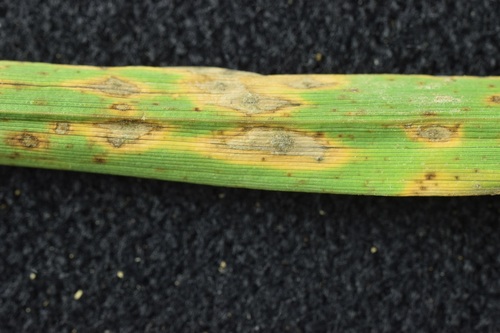
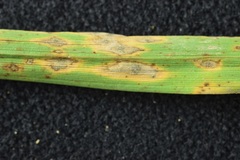 Pyricularia oryzaee0pathogen
- Outcome
- resistance to M. oryzae isolate ZB15e0
- Direction
- enhancede0
Organisms pictured · Representative pictures of the matched species, not figures from the paper.
Verbatim
e0“OsPIE3 loss-of-function mutants exhibited enhanced resistance to M. oryzae isolate ZB15”
t0“rice”
Claim · model-written summary
OsPIE3 overexpression mutants have reduced resistance to blast.
- Taxon
- riceOryza sativat0
- Material
- mutants with overexpressed OsPIE3e0
- Outcome
- resistancee0
- Direction
- reducede0
Organisms pictured · Representative pictures of the matched species, not figures from the paper.
Verbatim
e0“mutants with overexpressed OsPIE3 exhibited reduced resistance”
t0“rice”
Claim · model-written summary
The OsPIE3/PID2 double mutant has a blast phenotype similar to the PID2 single mutant.
- Taxon
- riceOryza sativat0
- Material
- OsPIE3/PID2-double mutante0
- Outcome
- blast phenotypee0
- Direction
- similare0
- Comparator
- PID2 single mutante0
Organisms pictured · Representative pictures of the matched species, not figures from the paper.
Verbatim
e0“the OsPIE3/PID2-double mutant displayed a similar blast phenotype to that of the PID2 single mutant”
t0“rice”
Claim · model-written summary
OsPIE3 is inferred to negatively regulate blast resistance along with PID2.
- Taxon
- riceOryza sativat0
- Gene
- OsPIE3e0
- Outcome
- blast disease resistancee0
- Qualifier
- negative regulatore0
Organisms pictured · Representative pictures of the matched species, not figures from the paper.
Verbatim
e0“OsPIE3 is a negative regulator and functions along with PID2 in blast disease resistance”
t0“rice”
The same questions in other papers
cysteine · nutrient: content · Oryza sativa (rice)Results agree
1 paper in the same direction as this paper
- negative
climate site · nutrient: content · Oryza sativa (rice)Positive and negative results
6 papers in the same direction as this paper · 26 in the opposite direction
- positive
- positive
- positive
29 papers more in this group
See all 33 papers →Claims are grouped by organism, treatment and what was measured or targeted. A paper counts as positive when any of its claims in the group is positive.