Abstract
The deleterious effects of salts on plants exposed to high solar radiation tend to be more accelerated due to the increase of toxic ions in the aerial plant part. Consequently, the physiological and biochemical processes will be affected. These effects can be minimized, however, with the use of management strategies, such as the use of a shading screen and a protected environment. In this sense, the objective of this work was to evaluate the physiological responses of sugar beet cultivated in different environments and irrigated with saline water. The experiment was conducted in an experimental design entirely randomized, using the factorial scheme 3 × 2, equivalent to three environments (FS = full sun; SSOS = shading screen open on the sides and PE = protected environment) and two electrical conductivities of the irrigation water (0.5 and 6.2 dS m-1), with four repetitions. At 45 days after sowing (DAS) the following variables were analyzed: stomatal conductance, liquid photosynthesis, transpiration, internal CO2 concentration, leaf temperature, instantaneous water use efficiency, instantaneous carboxylation efficiency, intrinsic water use efficiency, and relative chlorophyll index. Irrigation with water of higher salinity negatively affected stomatal conductance, net photosynthesis, leaf temperature and instantaneous water use efficiency of sugar beet plants grown in a full sun environment. The protected environment and open shading on the sides partially mitigated the deleterious effects of salinity. Keywords: Beta vulgaris L., gas exchange, salinity levels.
Abstract from the paper’s OpenAlex record; open copy licensed cc-by. Read at the source ↗
The text the model read, with the source record’s inline markup (italics, sub- and superscripts) rendered and its character entities decoded; quote offsets refer to the raw text.
Claims 2
Claim · model-written summary
Higher-salinity irrigation negatively affected stomatal conductance, net photosynthesis, leaf temperature and instantaneous water use efficiency in full-sun sugar beet.
- Taxon
- sugar beet
 Beta vulgaris subsp. vulgarise0
- Treatment
- water of higher salinitye0
- Outcome
- stomatal conductance, net photosynthesis, leaf temperature and instantaneous water use efficiencye0
- Direction
- negatively affectede0
- Setting
- full sun environmente0
Not reportedComparator
Organisms pictured · Representative pictures of the matched species, not figures from the paper.

Verbatim
e0“Irrigation with water of higher salinity negatively affected stomatal conductance, net photosynthesis, leaf temperature and instantaneous water use efficiency of sugar beet plants grown in a full sun environment.”
Claim · model-written summary
Protected and open-sided shaded environments partially mitigated salinity damage in sugar beet.
- Taxon
- beet
 Beta vulgarist0
- Treatment
- protected environment and open shading on the sidese0
- Outcome
- deleterious effects of salinitye0
- Direction
- partially mitigatede0
Not reportedComparator
Organisms pictured · Representative pictures of the matched species, not figures from the paper.
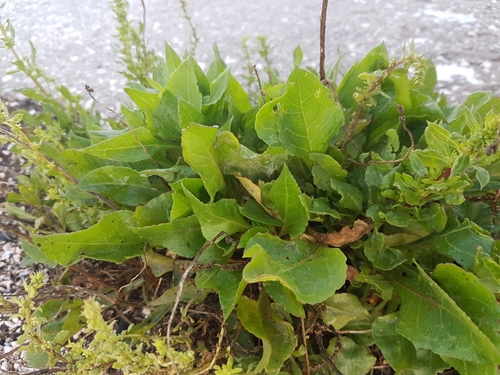
Verbatim
e0“The protected environment and open shading on the sides partially mitigated the deleterious effects of salinity.”
t0“beet crop”
The same questions in other papers
salinity · physiology: photosynthesis · Beta vulgaris (beet)Positive and negative results
11 papers in the same direction as this paper · 2 in the opposite direction
- no effect
- negative
- positive
10 papers more in this group
See all 14 papers →Claims are grouped by organism, treatment and what was measured or targeted. A paper counts as positive when any of its claims in the group is positive.