Abstract
Managing soil-borne pathogens is complex due to the restriction of the most effective synthetic fungicides for soil treatment. In this study, we showed that seed priming with Jania adhaerens water-soluble polysaccharides (JA WSPs) was successful in protecting tomato plants from the soil-borne pathogens Rhizoctonia solani, Pythium ultimum, and Fusarium oxysporum under greenhouse conditions. WSPs were extracted from dry thallus by autoclave-assisted method, and the main functional groups were characterized by using FT-IR spectroscopy. WSPs were applied by seed treatment at 0.3, 0.6 and 1.2 mg/mL doses, and each pathogen was inoculated singly in a growing substrate before seeding/transplant. Overall, WSPs increased seedling emergence, reduced disease severity and increased plant development depending on the dose. Transcriptional expression of genes related to phenylpropanoid, chlorogenic acid, SAR and ISR pathways, and chitinase and β-1,3 glucanase activities were investigated. Among the studied genes, HQT, HCT, and PR1 were significantly upregulated depending on the dose, while all doses increased PAL and PR2 expression as well as β-1,3 glucanase activity. These results demonstrated that, besides their plant growth promotion activity, JA WSPs may play a protective role in triggering plant defense responses potentially correlated to disease control against soil-borne pathogens.
Abstract from the paper’s OpenAlex record; open copy licensed cc-by. Read at the source ↗
The text the model read, with the source record’s inline markup (italics, sub- and superscripts) rendered and its character entities decoded; quote offsets refer to the raw text.
Claims 9
Claim · model-written summary
Jania polysaccharide priming protected tomato against Rhizoctonia solani.
- Taxon
- tomato plants
 Solanum lycopersicume0
- Treatment
- seed priming with Jania adhaerens water-soluble polysaccharides (JA WSPs)e0
- Interactor
- Rhizoctonia solani
 Rhizoctonia solanie0pathogen
- Second interactor
- Jania adhaerens
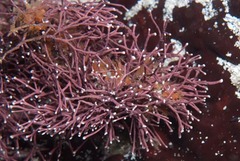 Jania pedunculata var. adhaerense0other
- Outcome
- protecting tomato plantse0
- Setting
- greenhouse conditionse0
Not reportedComparatorDirection
Organisms pictured · Representative pictures of the matched species, not figures from the paper.


Verbatim
e0“seed priming with Jania adhaerens water-soluble polysaccharides (JA WSPs) was successful in protecting tomato plants from the soil-borne pathogens Rhizoctonia solani, Pythium ultimum, and Fusarium oxysporum under greenhouse conditions”
Claim · model-written summary
Jania polysaccharide priming protected tomato against Pythium ultimum.
- Taxon
- tomato plantsSolanum lycopersicume0
- Treatment
- seed priming with Jania adhaerens water-soluble polysaccharides (JA WSPs)e0
- Interactor
- Pythium ultimumGlobisporangium ultimume0pathogen
- Outcome
- protecting tomato plantse0
- Setting
- greenhouse conditionse0
Not reportedComparatorDirection
Organisms pictured · Representative pictures of the matched species, not figures from the paper.
Verbatim
e0“seed priming with Jania adhaerens water-soluble polysaccharides (JA WSPs) was successful in protecting tomato plants from the soil-borne pathogens Rhizoctonia solani, Pythium ultimum, and Fusarium oxysporum under greenhouse conditions”
Claim · model-written summary
Jania polysaccharide priming protected tomato against Fusarium oxysporum.
- Taxon
- tomato plantsSolanum lycopersicume0
- Treatment
- seed priming with Jania adhaerens water-soluble polysaccharides (JA WSPs)e0
- Interactor
- Fusarium oxysporum
 Fusarium oxysporume0pathogen
- Outcome
- protecting tomato plantse0
- Setting
- greenhouse conditionse0
Not reportedComparatorDirection
Organisms pictured · Representative pictures of the matched species, not figures from the paper.

Verbatim
e0“seed priming with Jania adhaerens water-soluble polysaccharides (JA WSPs) was successful in protecting tomato plants from the soil-borne pathogens Rhizoctonia solani, Pythium ultimum, and Fusarium oxysporum under greenhouse conditions”
Claim · model-written summary
Polysaccharide treatment increased tomato seedling emergence.
- Taxon
- TomatoSolanum lycopersicumt0
- Treatment
- WSPse0
- Outcome
- seedling emergencee0
- Direction
- increasede0
- Qualifier
- depending on the dosee0
Not reportedComparator
Organisms pictured · Representative pictures of the matched species, not figures from the paper.
Verbatim
e0“Overall, WSPs increased seedling emergence, reduced disease severity and increased plant development depending on the dose.”
t0“Tomato”
Claim · model-written summary
Polysaccharide treatment reduced tomato disease severity.
- Taxon
- TomatoSolanum lycopersicumt0
- Treatment
- WSPse0
- Outcome
- disease severitye0
- Direction
- reducede0
- Qualifier
- depending on the dosee0
Not reportedComparator
Organisms pictured · Representative pictures of the matched species, not figures from the paper.
Verbatim
e0“Overall, WSPs increased seedling emergence, reduced disease severity and increased plant development depending on the dose.”
t0“Tomato”
Claim · model-written summary
Polysaccharide treatment increased tomato plant development.
- Taxon
- TomatoSolanum lycopersicumt0
- Treatment
- WSPse0
- Outcome
- plant developmente0
- Direction
- increasede0
- Qualifier
- depending on the dosee0
Not reportedComparator
Organisms pictured · Representative pictures of the matched species, not figures from the paper.
Verbatim
e0“Overall, WSPs increased seedling emergence, reduced disease severity and increased plant development depending on the dose.”
t0“Tomato”
Claim · model-written summary
HQT, HCT and PR1 were significantly upregulated depending on polysaccharide dose.
- Taxon
- TomatoSolanum lycopersicumt0
- Gene
- HQT, HCT, and PR1e0
- Outcome
- HQT, HCT, and PR1e0
- Direction
- upregulatede0
- Qualifier
- depending on the dosee0
Not reportedTreatmentComparator
Organisms pictured · Representative pictures of the matched species, not figures from the paper.
Verbatim
e0“HQT, HCT, and PR1 were significantly upregulated depending on the dose”
t0“Tomato”
Claim · model-written summary
All tested polysaccharide doses increased PAL and PR2 expression.
- Taxon
- TomatoSolanum lycopersicumt0
- Treatment
- all dosese0
- Gene
- PAL and PR2e0
- Outcome
- PAL and PR2 expressione0
- Direction
- increasede0
Not reportedComparator
Organisms pictured · Representative pictures of the matched species, not figures from the paper.
Verbatim
e0“all doses increased PAL and PR2 expression as well as β-1,3 glucanase activity”
t0“Tomato”
Claim · model-written summary
All tested polysaccharide doses increased β-1,3 glucanase activity.
- Taxon
- TomatoSolanum lycopersicumt0
- Treatment
- all dosese0
- Gene
- β-1,3 glucanasee0
- Outcome
- β-1,3 glucanase activitye0
- Direction
- increasede0
Not reportedComparator
Organisms pictured · Representative pictures of the matched species, not figures from the paper.
Verbatim
e0“all doses increased PAL and PR2 expression as well as β-1,3 glucanase activity”
t0“Tomato”
The same questions in other papers
seed treatment · Rhizoctonia solani · Solanum lycopersicum (tomato)Positive and negative results
6 papers in the same direction as this paper · 1 in the opposite direction
- negative
- positive
- positive
4 papers more in this group
See all 8 papers →seed treatment · Fusarium oxysporum · Solanum lycopersicum (tomato)Results agree
8 papers in the same direction as this paper
- positive
- positive
- positive
5 papers more in this group
See all 9 papers →Claims are grouped by organism, treatment and what was measured or targeted. A paper counts as positive when any of its claims in the group is positive.