Abstract
Global warming is a problem that must be addressed through various mitigation efforts. One of the mitigation efforts is to increase the number of trees and plants that absorb carbon dioxide from the atmosphere. The purpose of this study is to inventory the types of trees in Mulawarman University's green open space environment on the Mount Kelua Campus in Samarinda, East Kalimantan. Data was collected by establishing plots in three green open space locations: next to Kurusetra, next to the guest house Unmul, and behind the workshop Fahutan Unmul. The study discovered the greatest number of tree individuals is Shorea leprosa Miq, with as many as 38 individuals in green open space near University of Mulawarman Guesthouse. In terms of biomass and carbon accumulation, the species of Hevea brasiliensis had the highest values, reaching 964 kg/species and 453.1 kg/species, respectively. Meanwhile, the potential for carbon dioxide absorption in Artocarpus odoratissimus Blanco is the highest at 3382.6 kg/species. The three locations of green open space campuses have the potential to have carbon uptake that is still increasing, enabling green open space to function as a means of conservation education and support optimal environmental comfort.
Abstract from the paper’s OpenAlex record; open copy licensed cc-by-sa. Read at the source ↗
The text the model read, with the source record’s inline markup (italics, sub- and superscripts) rendered and its character entities decoded; quote offsets refer to the raw text.
Claims 5
Claim · model-written summary
Shorea leprosa Miq had the greatest number of individuals, 38, near the university guesthouse.
Verbatim
e0“the greatest number of tree individuals is Shorea leprosa Miq, with as many as 38 individuals in green open space near University of Mulawarman Guesthouse”
Claim · model-written summary
Hevea brasiliensis had the highest biomass, 964 kg/species.
- Taxon
- Hevea brasiliensis
 Hevea brasiliensise0
- Outcome
- biomasse0
- Direction
- higheste0
- Value
- 964 kg/speciese0
Organisms pictured · Representative pictures of the matched species, not figures from the paper.
Verbatim
e0“In terms of biomass and carbon accumulation, the species of Hevea brasiliensis had the highest values, reaching 964 kg/species and 453.1 kg/species, respectively”
Claim · model-written summary
Hevea brasiliensis had the highest carbon accumulation, 453.1 kg/species.
- Taxon
- Hevea brasiliensisHevea brasiliensise0
- Outcome
- carbon accumulatione0
- Direction
- higheste0
- Value
- 453.1 kg/speciese0
Organisms pictured · Representative pictures of the matched species, not figures from the paper.
Verbatim
e0“In terms of biomass and carbon accumulation, the species of Hevea brasiliensis had the highest values, reaching 964 kg/species and 453.1 kg/species, respectively”
Claim · model-written summary
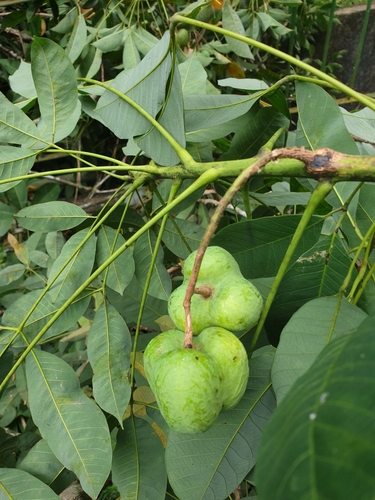
Artocarpus odoratissimus Blanco had the highest potential carbon dioxide absorption, 3382.6 kg/species.
- Taxon
- Artocarpus odoratissimus Blanco
 Artocarpus odoratissimuse0
- Outcome
- potential for carbon dioxide absorptione0
- Direction
- higheste0
- Value
- 3382.6 kg/speciese0
Organisms pictured · Representative pictures of the matched species, not figures from the paper.

Verbatim
e0“the potential for carbon dioxide absorption in Artocarpus odoratissimus Blanco is the highest at 3382.6 kg/species”
Claim · model-written summary
The three campus green spaces have potential for increasing carbon uptake.
Verbatim
e0“The three locations of green open space campuses have the potential to have carbon uptake that is still increasing”
t0“Beberapa Ruang Terbuka Hijau Kampus Universitas Mulawarman Gunung Kelua Samarinda”
e1“increase the number of trees and plants that absorb carbon dioxide”