Abstract
The use of chemical fertilizers as a supplemental source of nutrients has been on the increase but they are not applied in balanced proportion by most farmers [1]. Also, fertilizer requirements of the mixed intercropping systems have been a matter of conjecture; some studies had suggested that fertilizer requirements of the dominant component be applied [2], others recommend that the sum of the sole crop requirements, be applied [3]. Teriah [4], however, stated that both practices have proved either inadequate or wasteful. In this experiment the effects of different rates of NPK 15-15-15 fertilizer application on growth and yield of hot pepper and Egusi melon in an intercropping system was examined to determine optimum rate for production. The experiment was carried out at the Teaching and Research Farm of the Federal University of Agriculture Abeokuta, in the south western part of Nigeria. It took place from March to October 2017 during the growing season. The experiment was laid out in a Randomized Complete Block Design (RCBD) with 5 treatments (fertilizer rates) and 3 replicates. Treatments were; 0, 100, 200, 300 and 400 kg/ha of NPK 15-15-15 applications. Plot size was 3m by 3m with a 1.5m gang way round each plot to reduce inter-plot effect. Data were collected on growth parameters at 6 weeks after treatment (WAT) and continued at two-week intervals until 10 WAT. Four plants each of pepper and Egusi melon from the inner rows were randomly selected and tagged for the purpose of data collection. Data on yield were also collected at ripening. Analysis of variance (ANOVA) was carried out on each observation and the Least Significant Difference (LSD) was used for means separation (P≤0.05). The effects of fertilizer rates showed significant difference on pepper plant height, number of leaves, number of branches and leaf area. However, there was no significant difference in the effect of fertilizer rate on days to 50% flowering of pepper. Number of vines and vine length of Egusi melon were significantly different in their responses to fertilizer rates but the leaf area and days to 50% flowering of melon were similar at the various treatment levels. Meanwhile, total fruit yield of pepper, number of Egusi melon pods per hectare and the dry matter yield of Egusi melon showed significant difference. It was concluded from the study that the growth and yield of pepper and Egusi melon in intercrop increased with increase in fertilizer rate up to 400Kg/ha of NPK (15:15:15). However, higher fertilizer application rates should be explored in future studies for a better yield increase. These studies should be carried out with various compositions of inorganic and organic fertilizer application rates to ensure sustainable fertilizer application and to also preserve the natural fertility of the soil.
Abstract from the paper’s OpenAlex record, shown for indexing and research. Copyright remains with the authors or the publisher. Read at the source ↗
The text the model read, with the source record’s inline markup (italics, sub- and superscripts) rendered and its character entities decoded; quote offsets refer to the raw text.
Claims 12
Claim · model-written summary
Fertilizer rates significantly affected pepper plant height, leaf number, branch number, and leaf area.
- Taxon
- peppere0
- Treatment
- fertilizer ratese0
- Outcome
- pepper plant height, number of leaves, number of branches and leaf areae0
Not reportedComparatorDirection
Verbatim
e0“The effects of fertilizer rates showed significant difference on pepper plant height, number of leaves, number of branches and leaf area”
Claim · model-written summary
Fertilizer rate did not significantly affect days to 50% flowering in pepper.
- Taxon
- peppere0
- Treatment
- fertilizer ratee0
- Outcome
- days to 50% flowering of peppere0
- Direction
- no significant differencee0
Not reportedComparator
Verbatim
e0“there was no significant difference in the effect of fertilizer rate on days to 50% flowering of pepper”
Claim · model-written summary
Egusi melon vine number and length differed significantly across fertilizer rates.
- Taxon
- Egusi melon
 Citrullus mucosospermuse0
- Treatment
- fertilizer ratese0
- Outcome
- Number of vines and vine lengthe0
Not reportedComparatorDirection
Organisms pictured · Representative pictures of the matched species, not figures from the paper.
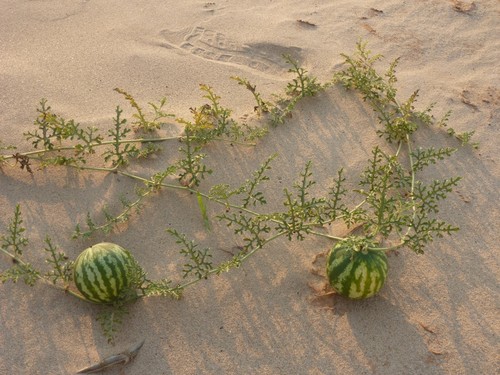
Verbatim
e0“Number of vines and vine length of Egusi melon were significantly different in their responses to fertilizer rates”
Claim · model-written summary
Egusi melon leaf area was similar across fertilizer rates.
- Taxon
- melon
 Cucumis meloe0
- Treatment
- various treatment levelse0
- Outcome
- leaf areae0
- Direction
- similare0
Not reportedComparator
Organisms pictured · Representative pictures of the matched species, not figures from the paper.

Verbatim
e0“the leaf area and days to 50% flowering of melon were similar at the various treatment levels”
Claim · model-written summary
Egusi melon days to 50% flowering were similar across fertilizer rates.
- Taxon
- melonCucumis meloe0
- Treatment
- various treatment levelse0
- Outcome
- days to 50% flowering of melone0
- Direction
- similare0
Not reportedComparator
Organisms pictured · Representative pictures of the matched species, not figures from the paper.
Verbatim
e0“the leaf area and days to 50% flowering of melon were similar at the various treatment levels”
Claim · model-written summary
Pepper total fruit yield differed significantly across fertilizer rates.
Not reportedComparatorDirection
Verbatim
e0“total fruit yield of pepper, number of Egusi melon pods per hectare and the dry matter yield of Egusi melon showed significant difference”
t0“Fertilizer Rate”
e1“The effects of fertilizer rates showed significant difference”
Claim · model-written summary
Egusi melon pod number per hectare differed significantly across fertilizer rates.
- Taxon
- Egusi melonCitrullus mucosospermuse0
- Treatment
- Fertilizer Ratet0
- Outcome
- number of Egusi melon pods per hectaree0
Not reportedComparatorDirection
Organisms pictured · Representative pictures of the matched species, not figures from the paper.
Verbatim
e0“total fruit yield of pepper, number of Egusi melon pods per hectare and the dry matter yield of Egusi melon showed significant difference”
t0“Fertilizer Rate”
Claim · model-written summary
Egusi melon dry matter yield differed significantly across fertilizer rates.
- Taxon
- Egusi melonCitrullus mucosospermuse0
- Treatment
- Fertilizer Ratet0
- Outcome
- dry matter yield of Egusi melone0
Not reportedComparatorDirection
Organisms pictured · Representative pictures of the matched species, not figures from the paper.
Verbatim
e0“total fruit yield of pepper, number of Egusi melon pods per hectare and the dry matter yield of Egusi melon showed significant difference”
t0“Fertilizer Rate”
Claim · model-written summary
Intercrop growth and yield of pepper rose with fertilizer rate up to 400Kg/ha.
- Taxon
- peppere0
- Treatment
- fertilizer rate up to 400Kg/ha of NPK (15:15:15)e0
- Outcome
- growth and yield of peppere0
- Direction
- increasede0
Not reportedComparator
Verbatim
e0“the growth and yield of pepper and Egusi melon in intercrop increased with increase in fertilizer rate up to 400Kg/ha of NPK (15:15:15)”
Claim · model-written summary
Intercrop growth and yield of Egusi melon rose with fertilizer rate up to 400Kg/ha.
- Taxon
- Egusi melonCitrullus mucosospermuse0
- Treatment
- fertilizer rate up to 400Kg/ha of NPK (15:15:15)e0
- Outcome
- growth and yield of pepper and Egusi melon in intercrope0
- Direction
- increasede0
Not reportedComparator
Organisms pictured · Representative pictures of the matched species, not figures from the paper.
Verbatim
e0“the growth and yield of pepper and Egusi melon in intercrop increased with increase in fertilizer rate up to 400Kg/ha of NPK (15:15:15)”
Claim · model-written summary
Higher fertilizer rates should be examined for yield improvement.
Verbatim
e0“higher fertilizer application rates should be explored in future studies for a better yield increase”
t0“Hot Pepper”
Claim · model-written summary
The authors recommend testing inorganic and organic fertilizer compositions.
- Taxon
- Egusi MelonCitrullus mucosospermust0
- Outcome
- various compositions of inorganic and organic fertilizer application ratese0
Organisms pictured · Representative pictures of the matched species, not figures from the paper.
Verbatim
e0“These studies should be carried out with various compositions of inorganic and organic fertilizer application rates to ensure sustainable fertilizer application and to also preserve the natural fertility of the soil”
t0“Egusi Melon”
The same questions in other papers
fertilization · yield · Citrullus mucosospermus (egusi melon)Results agree
3 papers in the same direction as this paper
- positive
- positive
- positive
Claims are grouped by organism, treatment and what was measured or targeted. A paper counts as positive when any of its claims in the group is positive.