Abstract
Fungal Fungi diversity and community composition are mainly depending on soil and vegetation factors. However, the effects of these drivers on different fungal taxonomy and functional guilds remain largely unexplored, especially in subtropical forest ecosystems. The soil was collected from five dominate tree species forests: Castanopsis carlesii, Castanopsis fabri, Cinnamomum chekiangense, Schima superb, and Cunninghamia lanceolata in Wanmulin National Nature Reserve of South-eastern China. Fungal communities in rhizosphere and bulk soil were assessed employing ITS rDNA illumina sequencing. Ascomycota dominated the fungal community and most of them belong to Saprotrophic fungal group. On the genus level, Cladophialophora, Spirosphaera, and Podospora were dominate in soils of Castanopsis carlesii, Castanopsis fabri, and Cinnamomum chekiangense (> 50% of the OTUs), respectively. Analysis of similarity showed that the Ascomycota and Saprotrophic fungi rather than total fungal community were significantly different among the soils with different dominant tree species. Furthermore, Ascomycota community were affected by soil C, C/N, and total K, while Saprotrophic fungi were explained by changes in tree richness, diameter at breast height and soil available P. In conclusion, our analyses revealed that the effects of dominant tree species on soil fungi are largely depend on different taxonomic and functional groups levels.
Abstract from the paper’s OpenAlex record; open copy licensed cc-by-nc-sa. Read at the source ↗
The text the model read, with the source record’s inline markup (italics, sub- and superscripts) rendered and its character entities decoded; quote offsets refer to the raw text.
Claims 9
Claim · model-written summary
Ascomycota dominated the fungal community, mostly in the saprotrophic group.
- Taxon
- tree speciest0
- Interactor
- AscomycotaAscomycotae0other
- Outcome
- Ascomycota dominated the fungal communitye0
Verbatim
e0“Ascomycota dominated the fungal community and most of them belong to Saprotrophic fungal group.”
t0“tree species”
Claim · model-written summary
Cladophialophora dominated Castanopsis carlesii soil fungal OTUs.
- Taxon
- Castanopsis carlesii
 Castanopsis carlesiie0
- Interactor
- Cladophialophora
 Cladophialophorae0other
- Outcome
- Cladophialophorae0
- Value
- > 50%e0
Organisms pictured · Representative pictures of the matched species, not figures from the paper.


Verbatim
e0“Cladophialophora, Spirosphaera, and Podospora were dominate in soils of Castanopsis carlesii, Castanopsis fabri, and Cinnamomum chekiangense (> 50% of the OTUs), respectively.”
Claim · model-written summary
Spirosphaera dominated Castanopsis fabri soil fungal OTUs.
- Taxon
- Castanopsis fabrie0
- Interactor
- Spirosphaera
 Spirosphaerae0other
- Outcome
- Spirosphaerae0
- Value
- > 50%e0
Organisms pictured · Representative pictures of the matched species, not figures from the paper.
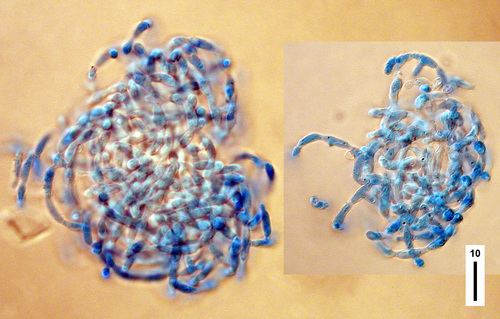
Verbatim
e0“Cladophialophora, Spirosphaera, and Podospora were dominate in soils of Castanopsis carlesii, Castanopsis fabri, and Cinnamomum chekiangense (> 50% of the OTUs), respectively.”
Claim · model-written summary
Podospora dominated Cinnamomum chekiangense soil fungal OTUs.
- Taxon
- Cinnamomum chekiangense
 Cinnamomum chekiangensee0
- Outcome
- Podosporae0
- Value
- > 50%e0
 Podospora
Organisms pictured · Representative pictures of the matched species, not figures from the paper.


Verbatim
e0“Cladophialophora, Spirosphaera, and Podospora were dominate in soils of Castanopsis carlesii, Castanopsis fabri, and Cinnamomum chekiangense (> 50% of the OTUs), respectively.”
Claim · model-written summary
Ascomycota communities differed significantly among soils with different dominant tree species.
Verbatim
e0“Ascomycota and Saprotrophic fungi rather than total fungal community were significantly different among the soils with different dominant tree species.”
t0“tree species”
Claim · model-written summary
Saprotrophic fungal communities differed significantly among soils with different dominant tree species.
Verbatim
e0“Ascomycota and Saprotrophic fungi rather than total fungal community were significantly different among the soils with different dominant tree species.”
t0“tree species”
Claim · model-written summary
Total fungal community composition did not differ significantly among dominant-tree soils.
Verbatim
e0“rather than total fungal community were significantly different among the soils with different dominant tree species.”
t0“tree species”
Claim · model-written summary
Ascomycota communities were associated with soil C, C/N and total K.
- Taxon
- tree speciest0
- Interactor
- AscomycotaAscomycotae0other
- Outcome
- Ascomycota communitye0
- Setting
- soil C, C/N, and total Ke0
Not reportedDirection
Verbatim
e0“Ascomycota community were affected by soil C, C/N, and total K”
t0“tree species”
Claim · model-written summary
Saprotrophic fungi were associated with tree richness, diameter at breast height and soil available P.
- Taxon
- tree speciest0
- Interactor
- Saprotrophic fungie0other
- Outcome
- Saprotrophic fungie0
- Setting
- tree richness, diameter at breast height and soil available Pe0
Not reportedDirection
Verbatim
e0“Saprotrophic fungi were explained by changes in tree richness, diameter at breast height and soil available P.”
t0“tree species”