Abstract
The productivity of a new bush winter squash cultivar ('Autumn Pride') was compared to that of 'Blue Hubbard', a high-yielding vine cultivar. Yields of 'Autumn Pride' increased with increasing plant density and, at high plant densities, were greater than yields of 'Blue Hubbard' at its near optimum plant density. Several factors could have contributed to the higher yield potential of 'Autumn Pride'. CO(,2) compensation points were determined to be 38 ppm and 77 ppm CO(,2) for 'Autumn Pride' and 'Blue Hubbard', respectively, at 30(DEGREES)C. 'Autumn Pride' had two layers of palisade parenchyma cells, occupying 74 percent of the mesophyll. In 'Blue Hubbard' leaves, the second layer of palisade parenchyma was often incompletely formed, so that palisade cells occupied only 52 percent of its mesophyll thickness. Leaf thickness was not found to be significantly different between 'Autumn Pride' and 'Blue Hubbard'. Due to its dwarf stem, all 'Autumn Pride' organs were more proximal to their leaves. Furthermore, stems and petioles of 'Autumn Pride' were larger in diameter and contained larger vascular bundles. ('14)C-sucrose label studies showed that translocation into sink organs over 24 hours was significantly higher in 'Autumn Pride' than in 'Blue Hubbard'. Greenhouse and field studies of partitioning showed that total biomass produced by bush ('Autumn Pride') and vine ('Blue Hubbard') plants were equal during the first eight weeks of growth. 'Blue Hubbard' plants partitioned a higher proportion of their dry weight into stems, while 'Autumn Pride' plants had more in leaves and roots. After the eighth week, 'Blue Hubbard' plants became significantly larger than 'Autumn Pride' plants, but 'Autumn Pride' plants had higher harvest indices throughout fruit development. Twelve weeks after transplanting, harvest indices were 70 per cent for 'Autumn Pride' and 57 per cent for 'Blue Hubbard' at low density planting. 'Autumn Pride' plants had a higher specific leaf weight (SLW), a lower leaf area ratio (LAR), and a higher cumulative net assimilation rate (NAR) than those of 'Blue Hubbard'.
Abstract from the paper’s OpenAlex record, shown for indexing and research. Copyright remains with the authors or the publisher. Read at the source ↗
The text the model read, with the source record’s inline markup (italics, sub- and superscripts) rendered and its character entities decoded; quote offsets refer to the raw text.
Claims 20
Claim · model-written summary
Autumn Pride yield rose with plant density.
- Taxon
- WINTER SQUASH
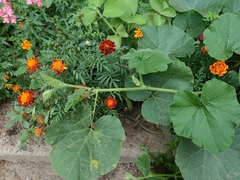 Cucurbita maximat0
- Material
- 'Autumn Pride'e0
- Treatment
- increasing plant densitye0
- Outcome
- Yieldse0
- Direction
- increasede0
Organisms pictured · Representative pictures of the matched species, not figures from the paper.

Verbatim
e0“Yields of 'Autumn Pride' increased with increasing plant density”
t0“WINTER SQUASH (CUCURBITA MAXIMA DUCH)”
Claim · model-written summary
At high density Autumn Pride yielded more than Blue Hubbard near its optimum density.
- Taxon
- WINTER SQUASHCucurbita maximat0
- Material
- 'Autumn Pride'e1
- Outcome
- Yieldse1
- Direction
- greatere0
- Qualifier
- at high plant densitiese0
- Comparator
- 'Blue Hubbard'e0
Organisms pictured · Representative pictures of the matched species, not figures from the paper.
Verbatim
e0“at high plant densities, were greater than yields of 'Blue Hubbard' at its near optimum plant density”
t0“WINTER SQUASH (CUCURBITA MAXIMA DUCH)”
e1“Yields of 'Autumn Pride' increased with increasing plant density”
Claim · model-written summary
Autumn Pride CO2 compensation point was 38 ppm.
- Taxon
- WINTER SQUASHCucurbita maximat0
- Material
- 'Autumn Pride'e0
- Outcome
- CO(,2) compensation pointse0
- Value
- 38 ppme0
- Qualifier
- at 30(DEGREES)Ce0
Organisms pictured · Representative pictures of the matched species, not figures from the paper.
Verbatim
e0“CO(,2) compensation points were determined to be 38 ppm and 77 ppm CO(,2) for 'Autumn Pride' and 'Blue Hubbard', respectively, at 30(DEGREES)C.”
t0“WINTER SQUASH (CUCURBITA MAXIMA DUCH)”
Claim · model-written summary
Blue Hubbard CO2 compensation point was 77 ppm.
- Taxon
- WINTER SQUASHCucurbita maximat0
- Material
- 'Blue Hubbard'e0
- Outcome
- CO(,2) compensation pointse0
- Value
- 77 ppm CO(,2)e0
- Qualifier
- at 30(DEGREES)Ce0
Organisms pictured · Representative pictures of the matched species, not figures from the paper.
Verbatim
e0“CO(,2) compensation points were determined to be 38 ppm and 77 ppm CO(,2) for 'Autumn Pride' and 'Blue Hubbard', respectively, at 30(DEGREES)C.”
t0“WINTER SQUASH (CUCURBITA MAXIMA DUCH)”
Claim · model-written summary
Autumn Pride had two palisade layers covering 74 percent of mesophyll.
- Taxon
- WINTER SQUASHCucurbita maximat0
- Material
- 'Autumn Pride'e0
- Organ / stage
- mesophylle0
- Outcome
- palisade parenchyma cellse0
- Value
- 74 percente0
Organisms pictured · Representative pictures of the matched species, not figures from the paper.
Verbatim
e0“'Autumn Pride' had two layers of palisade parenchyma cells, occupying 74 percent of the mesophyll.”
t0“WINTER SQUASH (CUCURBITA MAXIMA DUCH)”
Claim · model-written summary
Blue Hubbard second palisade layer was often incomplete and occupied 52 percent of mesophyll.
- Taxon
- WINTER SQUASHCucurbita maximat0
- Material
- 'Blue Hubbard'e0
- Organ / stage
- mesophylle0
- Outcome
- palisade cells occupiede0
- Value
- 52 percente0
Organisms pictured · Representative pictures of the matched species, not figures from the paper.
Verbatim
e0“In 'Blue Hubbard' leaves, the second layer of palisade parenchyma was often incompletely formed, so that palisade cells occupied only 52 percent of its mesophyll thickness.”
t0“WINTER SQUASH (CUCURBITA MAXIMA DUCH)”
Claim · model-written summary
Leaf thickness did not differ significantly between cultivars.
- Taxon
- WINTER SQUASHCucurbita maximat0
- Material
- 'Autumn Pride'e0
- Outcome
- Leaf thicknesse0
- Direction
- not found to be significantly differente0
- Comparator
- 'Blue Hubbard'e0
Organisms pictured · Representative pictures of the matched species, not figures from the paper.
Verbatim
e0“Leaf thickness was not found to be significantly different between 'Autumn Pride' and 'Blue Hubbard'.”
t0“WINTER SQUASH (CUCURBITA MAXIMA DUCH)”
Claim · model-written summary
Autumn Pride organs were nearer their leaves due to its dwarf stem.
- Taxon
- WINTER SQUASHCucurbita maximat0
- Material
- 'Autumn Pride'e0
- Outcome
- organs were more proximal to their leavese0
Organisms pictured · Representative pictures of the matched species, not figures from the paper.
Verbatim
e0“Due to its dwarf stem, all 'Autumn Pride' organs were more proximal to their leaves.”
t0“WINTER SQUASH (CUCURBITA MAXIMA DUCH)”
Claim · model-written summary
Autumn Pride stems and petioles had larger diameters and vascular bundles.
- Taxon
- WINTER SQUASHCucurbita maximat0
- Material
- 'Autumn Pride'e0
- Outcome
- stems and petioles ofe0
- Direction
- largere0
Organisms pictured · Representative pictures of the matched species, not figures from the paper.
Verbatim
e0“stems and petioles of 'Autumn Pride' were larger in diameter and contained larger vascular bundles.”
t0“WINTER SQUASH (CUCURBITA MAXIMA DUCH)”
Claim · model-written summary
Sucrose translocation into sink organs was higher in Autumn Pride over 24 hours.
- Taxon
- WINTER SQUASHCucurbita maximat0
- Material
- 'Autumn Pride'e0
- Outcome
- translocation into sink organse0
- Direction
- highere0
- Qualifier
- over 24 hourse0
- Comparator
- 'Blue Hubbard'e0
Organisms pictured · Representative pictures of the matched species, not figures from the paper.
Verbatim
e0“('14)C-sucrose label studies showed that translocation into sink organs over 24 hours was significantly higher in 'Autumn Pride' than in 'Blue Hubbard'.”
t0“WINTER SQUASH (CUCURBITA MAXIMA DUCH)”
Claim · model-written summary
The cultivars produced equal biomass in the first eight weeks.
- Taxon
- WINTER SQUASHCucurbita maximat0
- Material
- 'Autumn Pride'e0
- Outcome
- total biomasse0
- Direction
- equale0
- Qualifier
- during the first eight weeks of growthe0
- Comparator
- 'Blue Hubbard'e0
Organisms pictured · Representative pictures of the matched species, not figures from the paper.
Verbatim
e0“total biomass produced by bush ('Autumn Pride') and vine ('Blue Hubbard') plants were equal during the first eight weeks of growth.”
t0“WINTER SQUASH (CUCURBITA MAXIMA DUCH)”
Claim · model-written summary
Blue Hubbard allocated more dry mass to stems.
- Taxon
- WINTER SQUASHCucurbita maximat0
- Material
- 'Blue Hubbard'e0
- Outcome
- proportion of their dry weight into stemse0
- Direction
- highere0
Organisms pictured · Representative pictures of the matched species, not figures from the paper.
Verbatim
e0“'Blue Hubbard' plants partitioned a higher proportion of their dry weight into stems”
t0“WINTER SQUASH (CUCURBITA MAXIMA DUCH)”
Claim · model-written summary
Autumn Pride allocated more biomass to leaves and roots.
- Taxon
- WINTER SQUASHCucurbita maximat0
- Material
- 'Autumn Pride'e0
- Outcome
- leaves and rootse0
- Direction
- moree0
Organisms pictured · Representative pictures of the matched species, not figures from the paper.
Verbatim
e0“'Autumn Pride' plants had more in leaves and roots.”
t0“WINTER SQUASH (CUCURBITA MAXIMA DUCH)”
Claim · model-written summary
After week eight Blue Hubbard plants became larger.
- Taxon
- WINTER SQUASHCucurbita maximat0
- Material
- 'Blue Hubbard'e0
- Outcome
- plants became significantly largere0
- Direction
- largere0
- Comparator
- 'Autumn Pride'e0
Organisms pictured · Representative pictures of the matched species, not figures from the paper.
Verbatim
e0“After the eighth week, 'Blue Hubbard' plants became significantly larger than 'Autumn Pride' plants”
t0“WINTER SQUASH (CUCURBITA MAXIMA DUCH)”
Claim · model-written summary
Autumn Pride maintained higher harvest indices during fruit development.
- Taxon
- WINTER SQUASHCucurbita maximat0
- Material
- 'Autumn Pride'e0
- Outcome
- harvest indicese0
- Direction
- highere0
- Qualifier
- throughout fruit developmente0
Organisms pictured · Representative pictures of the matched species, not figures from the paper.
Verbatim
e0“'Autumn Pride' plants had higher harvest indices throughout fruit development.”
t0“WINTER SQUASH (CUCURBITA MAXIMA DUCH)”
Claim · model-written summary
Autumn Pride harvest index at twelve weeks was 70 per cent.
- Taxon
- WINTER SQUASHCucurbita maximat0
- Material
- 'Autumn Pride'e0
- Outcome
- harvest indicese0
- Value
- 70 per cente0
Organisms pictured · Representative pictures of the matched species, not figures from the paper.
Verbatim
e0“Twelve weeks after transplanting, harvest indices were 70 per cent for 'Autumn Pride' and 57 per cent for 'Blue Hubbard' at low density planting.”
t0“WINTER SQUASH (CUCURBITA MAXIMA DUCH)”
Claim · model-written summary
Blue Hubbard harvest index at twelve weeks was 57 per cent.
- Taxon
- WINTER SQUASHCucurbita maximat0
- Material
- 'Blue Hubbard'e0
- Outcome
- harvest indicese0
- Value
- 57 per cente0
Organisms pictured · Representative pictures of the matched species, not figures from the paper.
Verbatim
e0“Twelve weeks after transplanting, harvest indices were 70 per cent for 'Autumn Pride' and 57 per cent for 'Blue Hubbard' at low density planting.”
t0“WINTER SQUASH (CUCURBITA MAXIMA DUCH)”
Claim · model-written summary
Autumn Pride had higher specific leaf weight.
- Taxon
- WINTER SQUASHCucurbita maximat0
- Material
- 'Autumn Pride'e0
- Outcome
- specific leaf weight (SLW)e0
- Direction
- highere0
- Comparator
- 'Blue Hubbard'e0
Organisms pictured · Representative pictures of the matched species, not figures from the paper.
Verbatim
e0“'Autumn Pride' plants had a higher specific leaf weight (SLW), a lower leaf area ratio (LAR), and a higher cumulative net assimilation rate (NAR) than those of 'Blue Hubbard'.”
t0“WINTER SQUASH (CUCURBITA MAXIMA DUCH)”
Claim · model-written summary
Autumn Pride had lower leaf area ratio.
- Taxon
- WINTER SQUASHCucurbita maximat0
- Material
- 'Autumn Pride'e0
- Outcome
- leaf area ratio (LAR)e0
- Direction
- lowere0
- Comparator
- 'Blue Hubbard'e0
Organisms pictured · Representative pictures of the matched species, not figures from the paper.
Verbatim
e0“'Autumn Pride' plants had a higher specific leaf weight (SLW), a lower leaf area ratio (LAR), and a higher cumulative net assimilation rate (NAR) than those of 'Blue Hubbard'.”
t0“WINTER SQUASH (CUCURBITA MAXIMA DUCH)”
Claim · model-written summary
Autumn Pride had higher cumulative net assimilation rate.
- Taxon
- WINTER SQUASHCucurbita maximat0
- Material
- 'Autumn Pride'e0
- Outcome
- cumulative net assimilation rate (NAR)e0
- Direction
- highere0
- Comparator
- 'Blue Hubbard'e0
Organisms pictured · Representative pictures of the matched species, not figures from the paper.
Verbatim
e0“'Autumn Pride' plants had a higher specific leaf weight (SLW), a lower leaf area ratio (LAR), and a higher cumulative net assimilation rate (NAR) than those of 'Blue Hubbard'.”
t0“WINTER SQUASH (CUCURBITA MAXIMA DUCH)”