Abstract
In search for botanicals as an alternative remedy to synthetic chemicals in the pest control of tea plantations, ferns such as Adiantum raddianum, Asplenium aethiopicum, Cyclosorus interruptus, Dicranopteris linearis, Diplazium polypodioides, and Pteridium aquilinum were evaluated against the two major pests of tea, red spider mite Oligonychus coffeae Nietner and tea mosquito bug Helopeltis theivora Waterhouse, which are the foremost seasonal pests in tea fields, causing severe crop loss. Apart from synthetic chemicals, only the neem kernel extract is recommended in tea fields. The aqueous extracts of ferns were screened at different concentrations against these pests under laboratory and field conditions. The extracts of P. aquilinum and D. linearis showed good contact toxicity at a 5% concentration to O. coffeae. The acaricidal activity was observed in the order P. aquilinum > D. linearis > C. interruptus > A. raddianum > D. polypodioides > A. aethiopicum. Under field conditions, the extract of D. linearis and P. aquilinum showed a 50% reduction in the population of red spider mite and caused no phytotoxic effect to tea leaves. But their insecticidal activity was less pronounced against H. theivora. They exhibit antifeedant activity, which was sustained only for 24 hours. The photochemical screening of extracts showed a qualitatively increased level of saponins in P. aquilinum, D. linearis, and C. interruptus. The study shows that the aqueous extracts of D. linearis and P. aquilinum can be incorporated in the mite control programme in tea.
Abstract from the paper’s OpenAlex record; open copy licensed cc-by-nc. Read at the source ↗
The text the model read, with the source record’s inline markup (italics, sub- and superscripts) rendered and its character entities decoded; quote offsets refer to the raw text.
Claims 8
Claim · model-written summary
Extracts of P. aquilinum and D. linearis showed good contact toxicity to O. coffeae at a 5% concentration.
- Taxon
- teat0
- Treatment
- extracts of P. aquilinum and D. linearise1
- Interactor
- O. coffeaeOligonychus coffeaee1pest
- Outcome
- contact toxicitye1
Not reportedComparatorDirection
Verbatim
e1“The extracts of P. aquilinum and D. linearis showed good contact toxicity at a 5% concentration to O. coffeae”
t0“infesting tea”
Claim · model-written summary
Acaricidal activity of the fern extracts was observed in the order P. aquilinum > D. linearis > C. interruptus > A. raddianum > D. polypodioides > A. aethiopicum.
- Taxon
- teat0
- Treatment
- aqueous extracts of fernse6
- Outcome
- acaricidal activitye2
- Direction
- observed in the ordere2
Not reportedComparator
Verbatim
e2“The acaricidal activity was observed in the order P. aquilinum > D. linearis > C. interruptus > A. raddianum > D. polypodioides > A. aethiopicum”
e6“The aqueous extracts of ferns were screened at different concentrations against these pests”
t0“infesting tea”
Claim · model-written summary
Extracts of D. linearis and P. aquilinum reduced the red spider mite population by 50% under field conditions.
- Taxon
- teat0
- Treatment
- the extract of D. linearis and P. aquilinume3
- Interactor
- red spider mitee3pest
- Outcome
- population of red spider mitee3
- Direction
- reductione3
- Value
- 50%e3
- Setting
- field conditionse3
Not reportedComparator
Verbatim
e3“Under field conditions, the extract of D. linearis and P. aquilinum showed a 50% reduction in the population of red spider mite”
t0“infesting tea”
Claim · model-written summary
Extracts of D. linearis and P. aquilinum caused no phytotoxic effect on tea leaves.
Not reportedComparatorDirection
Verbatim
e3“Under field conditions, the extract of D. linearis and P. aquilinum showed a 50% reduction in the population of red spider mite”
e4“caused no phytotoxic effect to tea leaves”
Claim · model-written summary
Insecticidal activity of the fern extracts was less pronounced against H. theivora.
- Taxon
- teat0
- Treatment
- aqueous extracts of fernse6
- Interactor
- H. theivora
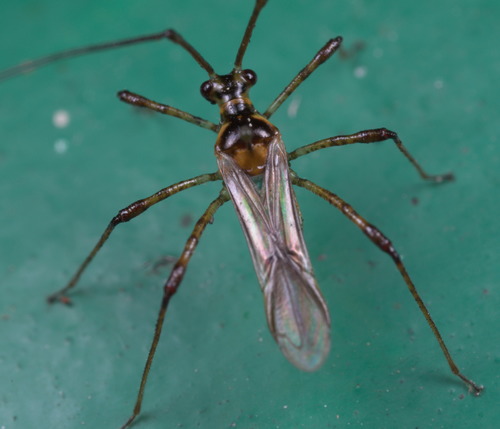
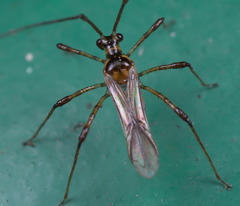 Helopeltis theivorae5pest
- Outcome
- insecticidal activitye5
- Direction
- less pronouncede5
Not reportedComparator
Organisms pictured · Representative pictures of the matched species, not figures from the paper.
Verbatim
e5“But their insecticidal activity was less pronounced against H. theivora”
e6“The aqueous extracts of ferns were screened at different concentrations against these pests”
t0“infesting tea”
Claim · model-written summary
Antifeedant activity of the fern extracts lasted only 24 hours.
Not reportedDirection
Verbatim
e6“They exhibit antifeedant activity, which was sustained only for 24 hours”
t0“infesting tea”
Claim · model-written summary
Extracts of P. aquilinum, D. linearis and C. interruptus showed a qualitatively increased level of saponins.
- Taxon
- P. aquilinum, D. linearis, and C. interruptus
 Pteridium aquilinum
 Dicranopteris linearis
 Cyclosorus interruptuse7
- Outcome
- level of saponinse7
- Direction
- increasede7
- Qualifier
- qualitativelye7
Organisms pictured · Representative pictures of the matched species, not figures from the paper.


Verbatim
e7“The photochemical screening of extracts showed a qualitatively increased level of saponins in P. aquilinum, D. linearis, and C. interruptus”
Claim · model-written summary
Aqueous extracts of D. linearis and P. aquilinum can be incorporated in the tea mite control programme.
Verbatim
e7“the aqueous extracts of D. linearis and P. aquilinum can be incorporated in the mite control programme in tea”
The same questions in other papers
botanical · Helopeltis theivora · Camellia sinensis (black tea)Positive and negative results
3 in the opposite direction
- positive
- positive
- positive
botanical · Oligonychus coffeae · Camellia sinensis (black tea)Positive and negative results
5 papers in the same direction as this paper · 1 in the opposite direction
- positive
- negative
- positive
3 papers more in this group
See all 7 papers →botanical · pest · Camellia sinensis (black tea)Positive and negative results
8 papers in the same direction as this paper · 1 in the opposite direction
- positive
- positive
- no effect
6 papers more in this group
See all 10 papers →Claims are grouped by organism, treatment and what was measured or targeted. A paper counts as positive when any of its claims in the group is positive.