Abstract
Sorghum is an alternative crop to produce grains in the off-season in Brazilian Cerrado and the intercropping with Brachiaria species enable to produce dry matter on the soil surface for a longer time. However, there is limited information on Brachiaria ruziziensis seed density to be applied to intercropping with sorghum without causing decreases in sorghum grain yield. The objective of the study was to evaluate the seeding density of B. ruziziensis in different intercropped systems with grain sorghum grown after soybean harvest, in off-season cultivation, to produce grains and the effects of straw on the agronomic performance of the soybean crop in succession to intercropping. This study was conducted in the field during the 2014 off-season in Rio Verde, Goiás. The experimental design was complete randomized blocks in a 3×5 factorial arranged with four replications corresponded to intercropping on rows, inter-rows and broadcast sowing with the densities of 2, 4, 6, 8 and 10 viable pure seeds m-2 of B. ruziziensis. Monocultures of sorghum and these forage crop were also evaluated. The results demonstrated the absence of effects of intercropping systems and seeding density on the yield of sorghum grains and on the cultivation of soybean in succession. The intercropping was effective in producing straw on soil surface to Cerrado no-tillage system. Key words: Brachiaria species, Glycine max, straw, off-season crop, Sorghum bicolor.
Abstract from the paper’s OpenAlex record; open copy licensed cc-by. Read at the source ↗
The text the model read, with the source record’s inline markup (italics, sub- and superscripts) rendered and its character entities decoded; quote offsets refer to the raw text.
Claims 3
Claim · model-written summary
Intercropping systems and Brachiaria seeding density did not affect sorghum grain yield.
- Taxon
- grain sorghum
 Sorghum bicolort0
- Treatment
- intercropping systems and seeding densitye0
- Interactor
- Brachiaria ruziziensis
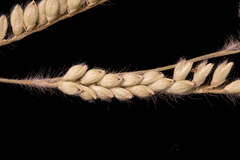 Urochloa ruziziensist0other
- Outcome
- yield of sorghum grainse0
- Direction
- absence of effectse0
Not reportedComparator
Organisms pictured · Representative pictures of the matched species, not figures from the paper.


Verbatim
e0“The results demonstrated the absence of effects of intercropping systems and seeding density on the yield of sorghum grains”
t0“Brachiaria ruziziensis intercropped with grain sorghum”
Claim · model-written summary
Intercropping systems and Brachiaria seeding density did not affect the succeeding soybean crop.
- Taxon
- soybean
 Glycine maxt0
- Treatment
- intercropping systems and seeding densitye0
- Outcome
- cultivation of soybean in successione0
- Direction
- absence of effectse0
Not reportedComparator
Organisms pictured · Representative pictures of the matched species, not figures from the paper.

Verbatim
e0“The results demonstrated the absence of effects of intercropping systems and seeding density on the yield of sorghum grains and on the cultivation of soybean in succession”
t0“effects on soybean in succession”
Claim · model-written summary
Intercropping produced straw on the soil surface for the Cerrado no-tillage system.
- Taxon
- Brachiaria ruziziensisUrochloa ruziziensist0
- Treatment
- intercroppinge0
- Outcome
- producing straw on soil surfacee0
- Setting
- Cerradoe0
Not reportedDirection
Organisms pictured · Representative pictures of the matched species, not figures from the paper.
Verbatim
e0“The intercropping was effective in producing straw on soil surface to Cerrado no-tillage system”
t0“Brachiaria ruziziensis intercropped with grain sorghum”
The same questions in other papers
density · organism · Glycine max (soybean)Positive and negative results
3 papers in the same direction as this paper · 1 in the opposite direction
- positive
- negative
- no effect
1 paper more in this group
See all 5 papers →intercropping · organism · Glycine max (soybean)Positive and negative results
10 papers in the same direction as this paper · 4 in the opposite direction
- positive
- positive
- positive
11 papers more in this group
See all 15 papers →Claims are grouped by organism, treatment and what was measured or targeted. A paper counts as positive when any of its claims in the group is positive.