Abstract
Cucurbita maxima is one of the most widely cultivated Cucurbitaceae in Heilongjiang province, China. The objectives of this study were to clarify the genetic diversity of 44 accessions from different geographical origins using morphological and molecular characteristics and to compare the consistency of these morphological and molecular characteristics. Morphological characteristics showed a large qualitative variability primarily according to fruit-related traits. Twenty-eight random-amplified polymorphic DNA (RAPD) markers produced 128 bands. Both morphological characteristics and RAPD markers grouped 44 accessions of C. maxima into four clusters, and the similarity coefficients ranged from 0.70 to 0.91 and from 0.40 to 0.98, respectively. DNA polymorphisms were highly consistent with phenotypic traits on rootstock C. maxima. The relationships between C. maxima from different origins were not clearly defined via morphological characteristics and RAPD analysis, suggesting some traits of C. maxima were specific to geographical location had disappeared or were weak in Heilongjiang province, which would not facilitate pumpkin breeding. Hybrid generations and their parent plants or sister lines were grouped into sub-clusters and showed little genetic distance according to both evaluation methods. Overall, morphological characteristics and RAPD markers were consistent and revealed high genetic diversity between C. maxima landraces from different origins.
Abstract from the paper’s OpenAlex record, shown for indexing and research. Copyright remains with the authors or the publisher. Read at the source ↗
The text the model read, with the source record’s inline markup (italics, sub- and superscripts) rendered and its character entities decoded; quote offsets refer to the raw text.
Claims 10
Claim · model-written summary
Cucurbita maxima accessions showed large qualitative variation, especially in fruit traits.
- Taxon
- Cucurbita maxima
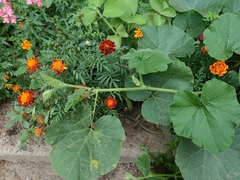 Cucurbita maximae0
- Organ / stage
- fruite1
- Outcome
- large qualitative variabilitye1
Organisms pictured · Representative pictures of the matched species, not figures from the paper.

Verbatim
e0“Cucurbita maxima is one”
e1“Morphological characteristics showed a large qualitative variability primarily according to fruit-related traits”
Claim · model-written summary
Twenty-eight RAPD markers generated 128 bands.
- Taxon
- Cucurbita maximaCucurbita maximae0
- Outcome
- bandse1
- Value
- 128 bandse1
Organisms pictured · Representative pictures of the matched species, not figures from the paper.
Verbatim
e0“Cucurbita maxima is one”
e1“Twenty-eight random-amplified polymorphic DNA (RAPD) markers produced 128 bands”
Claim · model-written summary
Morphological characteristics grouped 44 accessions into four clusters.
- Taxon
- C. maximaCucurbita maximae0
- Outcome
- four clusterse0
- Value
- four clusterse0
- Qualifier
- morphological characteristicse0
Organisms pictured · Representative pictures of the matched species, not figures from the paper.
Verbatim
e0“morphological characteristics and RAPD markers grouped 44 accessions of C. maxima into four clusters, and the similarity coefficients ranged from 0.70 to 0.91 and from 0.40 to 0.98, respectively”
Claim · model-written summary
RAPD markers grouped 44 accessions into four clusters.
- Taxon
- C. maximaCucurbita maximae0
- Outcome
- four clusterse0
- Value
- four clusterse0
- Qualifier
- RAPD markerse0
Organisms pictured · Representative pictures of the matched species, not figures from the paper.
Verbatim
e0“morphological characteristics and RAPD markers grouped 44 accessions of C. maxima into four clusters, and the similarity coefficients ranged from 0.70 to 0.91 and from 0.40 to 0.98, respectively”
Claim · model-written summary
Morphological similarity coefficients ranged from 0.70 to 0.91.
- Taxon
- C. maximaCucurbita maximae0
- Outcome
- similarity coefficientse0
- Value
- 0.70 to 0.91e0
- Qualifier
- morphological characteristicse0
Organisms pictured · Representative pictures of the matched species, not figures from the paper.
Verbatim
e0“morphological characteristics and RAPD markers grouped 44 accessions of C. maxima into four clusters, and the similarity coefficients ranged from 0.70 to 0.91 and from 0.40 to 0.98, respectively”
Claim · model-written summary
RAPD similarity coefficients ranged from 0.40 to 0.98.
- Taxon
- C. maximaCucurbita maximae0
- Outcome
- similarity coefficientse0
- Value
- 0.40 to 0.98e0
- Qualifier
- RAPD markerse0
Organisms pictured · Representative pictures of the matched species, not figures from the paper.
Verbatim
e0“morphological characteristics and RAPD markers grouped 44 accessions of C. maxima into four clusters, and the similarity coefficients ranged from 0.70 to 0.91 and from 0.40 to 0.98, respectively”
Claim · model-written summary
DNA polymorphisms were highly consistent with rootstock phenotypic traits.
- Taxon
- C. maximaCucurbita maximae0
- Material
- rootstock C. maximae0
- Outcome
- phenotypic traitse0
- Qualifier
- DNA polymorphisms were highly consistente0
Not reportedDirection
Organisms pictured · Representative pictures of the matched species, not figures from the paper.
Verbatim
e0“DNA polymorphisms were highly consistent with phenotypic traits on rootstock C. maxima”
Claim · model-written summary
Morphology and RAPD did not clearly resolve relationships among accessions from different origins.
- Taxon
- C. maximaCucurbita maximae0
- Outcome
- relationships between C. maxima from different originse0
- Comparator
- morphological characteristics and RAPD analysise0
Organisms pictured · Representative pictures of the matched species, not figures from the paper.
Verbatim
e0“The relationships between C. maxima from different origins were not clearly defined via morphological characteristics and RAPD analysis”
Claim · model-written summary
Hybrid generations, parents and sister lines had little genetic distance under both methods.
- Taxon
- C. maximaCucurbita maximae1
- Material
- Hybrid generations and their parent plants or sister linese0
- Outcome
- little genetic distancee0
Organisms pictured · Representative pictures of the matched species, not figures from the paper.
Verbatim
e0“Hybrid generations and their parent plants or sister lines were grouped into sub-clusters and showed little genetic distance according to both evaluation methods”
e1“accessions of C. maxima into four clusters”
Claim · model-written summary
Morphology and RAPD were consistent and revealed high diversity between landraces from different origins.
- Taxon
- C. maximaCucurbita maximae0
- Outcome
- high genetic diversity between C. maxima landraces from different originse0
- Comparator
- morphological characteristics and RAPD markerse0
Organisms pictured · Representative pictures of the matched species, not figures from the paper.
Verbatim
e0“Overall, morphological characteristics and RAPD markers were consistent and revealed high genetic diversity between C. maxima landraces from different origins”