Abstract
Jasmonate is an important endogenous chemical signal that plays a role in modulation of plant defense responses. To understand its mechanisms in regulation of rice resistance against the fungal pathogen Magnaporthe oryzae, comparative phenotype and proteomic analyses were undertaken using two near-isogenic cultivars with different levels of disease resistance. Methyl-jasmonate (MeJA) treatment significantly enhanced the resistance against M. oryzae in both cultivars but the treated resistant cultivar maintained a higher level of resistance than the same treated susceptible cultivars. Proteomic analysis revealed 26 and 16 MeJA-modulated proteins in resistant and susceptible cultivars, respectively, and both cultivars shared a common set of 13 proteins. Cumulatively, a total of 29 unique MeJA-influenced proteins were identified with many of them known to be associated with plant defense response and ROS accumulation. Consistent with the findings of proteomic analysis, MeJA treatment increased ROS accumulation in both cultivars with the resistant cultivar showing higher levels of ROS production and cell membrane damage than the susceptible cultivar. Taken together, our data add a new insight into the mechanisms of overall MeJA-induced rice defense response and provide a molecular basis of using MeJA to enhance fungal disease resistance in resistant and susceptible rice cultivars.
Abstract from the paper’s OpenAlex record, shown for indexing and research. Copyright remains with the authors or the publisher. Read at the source ↗
The text the model read, with the source record’s inline markup (italics, sub- and superscripts) rendered and its character entities decoded; quote offsets refer to the raw text.
Claims 10
Claim · model-written summary
MeJA significantly enhanced resistance against M. oryzae in both rice cultivars.
- Taxon
- rice
 Oryza sativat0
- Treatment
- Methyl-jasmonate (MeJA) treatmente0
- Interactor
- M. oryzae
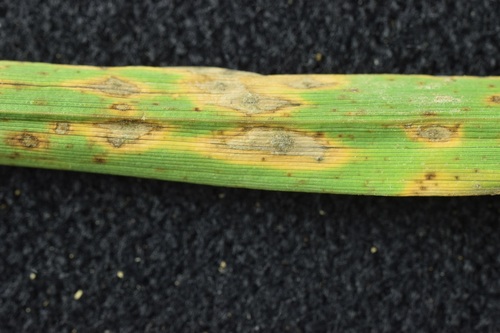
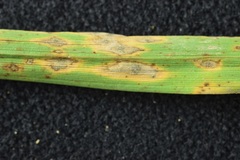 Pyricularia oryzaee0pathogen
- Outcome
- resistance against M. oryzaee0
- Direction
- enhancede0
Not reportedComparator
Organisms pictured · Representative pictures of the matched species, not figures from the paper.

Verbatim
e0“Methyl-jasmonate (MeJA) treatment significantly enhanced the resistance against M. oryzae in both cultivars”
t0“rice cultivars”
Claim · model-written summary
The treated resistant rice cultivar retained higher resistance than the treated susceptible cultivar.
- Taxon
- riceOryza sativat0
- Material
- resistant cultivare0
- Outcome
- resistancee0
- Direction
- highere0
- Comparator
- susceptible cultivarse0
Organisms pictured · Representative pictures of the matched species, not figures from the paper.
Verbatim
e0“the treated resistant cultivar maintained a higher level of resistance than the same treated susceptible cultivars”
t0“rice cultivars”
Claim · model-written summary
Proteomic analysis found 26 MeJA-modulated proteins in resistant rice cultivars.
- Taxon
- riceOryza sativat0
- Material
- resistante0
- Outcome
- MeJA-modulated proteinse0
- Value
- 26e0
Organisms pictured · Representative pictures of the matched species, not figures from the paper.
Verbatim
e0“26 and 16 MeJA-modulated proteins in resistant and susceptible cultivars, respectively”
t0“rice cultivars”
Claim · model-written summary
Proteomic analysis found 16 MeJA-modulated proteins in susceptible rice cultivars.
- Taxon
- riceOryza sativat0
- Material
- susceptible cultivarse0
- Outcome
- MeJA-modulated proteinse0
- Value
- 16e0
Organisms pictured · Representative pictures of the matched species, not figures from the paper.
Verbatim
e0“26 and 16 MeJA-modulated proteins in resistant and susceptible cultivars, respectively”
t0“rice cultivars”
Claim · model-written summary
The two rice cultivars shared 13 MeJA-modulated proteins.
- Taxon
- riceOryza sativat0
- Outcome
- proteinse0
- Value
- 13 proteinse0
Organisms pictured · Representative pictures of the matched species, not figures from the paper.
Verbatim
e0“both cultivars shared a common set of 13 proteins”
t0“rice cultivars”
Claim · model-written summary
A total of 29 unique MeJA-influenced proteins were identified in rice.
- Taxon
- riceOryza sativat0
- Outcome
- MeJA-influenced proteinse0
- Value
- 29 unique MeJA-influenced proteinse0
Organisms pictured · Representative pictures of the matched species, not figures from the paper.
Verbatim
e0“a total of 29 unique MeJA-influenced proteins were identified”
t0“rice cultivars”
Claim · model-written summary
Many MeJA-influenced rice proteins were known to be associated with defense response and ROS accumulation.
- Taxon
- riceOryza sativat0
- Gene
- proteinse1
- Outcome
- plant defense response and ROS accumulatione0
Not reportedDirection
Organisms pictured · Representative pictures of the matched species, not figures from the paper.
Verbatim
e0“many of them known to be associated with plant defense response and ROS accumulation”
e1“26 and 16 MeJA-modulated proteins in resistant and susceptible cultivars, respectively”
t0“rice cultivars”
Claim · model-written summary
MeJA increased ROS accumulation in both rice cultivars.
- Taxon
- riceOryza sativat0
- Treatment
- MeJA treatmente0
- Outcome
- ROS accumulatione0
- Direction
- increasede0
Not reportedComparator
Organisms pictured · Representative pictures of the matched species, not figures from the paper.
Verbatim
e0“MeJA treatment increased ROS accumulation in both cultivars”
t0“rice cultivars”
Claim · model-written summary
The resistant rice cultivar had higher ROS production than the susceptible cultivar after MeJA treatment.
- Taxon
- riceOryza sativat0
- Material
- resistant cultivare0
- Outcome
- ROS productione0
- Direction
- highere0
- Comparator
- susceptible cultivare0
Organisms pictured · Representative pictures of the matched species, not figures from the paper.
Verbatim
e0“the resistant cultivar showing higher levels of ROS production and cell membrane damage than the susceptible cultivar”
t0“rice cultivars”
Claim · model-written summary
The resistant rice cultivar had higher cell membrane damage than the susceptible cultivar after MeJA treatment.
- Taxon
- riceOryza sativat0
- Material
- resistant cultivare0
- Outcome
- cell membrane damagee0
- Direction
- highere0
- Comparator
- susceptible cultivare0
Organisms pictured · Representative pictures of the matched species, not figures from the paper.
Verbatim
e0“the resistant cultivar showing higher levels of ROS production and cell membrane damage than the susceptible cultivar”
t0“rice cultivars”
The same questions in other papers
(-)-methyl jasmonate · physiology: oxidative · Oryza sativa (rice)Positive and negative results
7 papers in the same direction as this paper · 2 in the opposite direction
- negative
- negative
- positive
6 papers more in this group
See all 10 papers →Claims are grouped by organism, treatment and what was measured or targeted. A paper counts as positive when any of its claims in the group is positive.