Abstract
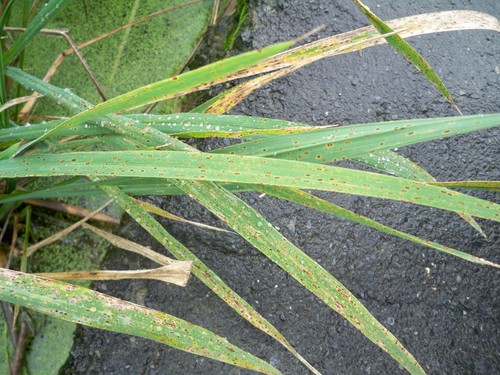
Chaetomium cochliodes proved to be a new antagonistic fungus against brown leaf spot of rice var Pittsanulok 2 caused by Drechslera oryzae. It showed good inhibition of mycelial growth of 38.18 per cent and inhibited inoculum production of 71.55 per cent. Crude extracts from Ch cochliodes using hexane, ethyl acetate and methanol at 1,000 ppm could significantly inhibited the inoculum production of rice pathogen 93.85 per cent which ED50 value was 66.45 ppm when compared to the control (0 ppm). Ch cochliodes was formulated in different forms for applying to control brown leaf spot of rice. Biological products formulated from Ch cochliodes were tested to control brown leaf spot of rice caused by D oryzae. Result showed that biopowder formulation gave significantly highest to control leaf spot and highest plant growth when compared to the non-treat control, followed by applying crude extract of Ch cochliodes, benlate and spore suspension of Ch cochliodes. Moreover, bio-powder formulation gave significantly increased in plant growth over 44 % and followed by crude extract of Ch cochliodes, spore suspension of Ch cochliodes and benlate.
Abstract from the paper’s OpenAlex record, shown for indexing and research. Copyright remains with the authors or the publisher. Read at the source ↗
The text the model read, with the source record’s inline markup (italics, sub- and superscripts) rendered and its character entities decoded; quote offsets refer to the raw text.
Claims 7
Claim · model-written summary
Chaetomium cochliodes inhibited Drechslera oryzae mycelial growth by 38.18 per cent.
- Taxon
- rice
 Oryza sativae0
- Material
- Pittsanulok 2e0
- Treatment
- Chaetomium cochliodese0
- Interactor
- Drechslera oryzae
 Bipolaris oryzaee0pathogen
- Second interactor
- Chaetomium cochliodesChaetomium cochliodese0biocontrol_agent
- Outcome
- mycelial growthe0
- Direction
- inhibitione0
- Value
- 38.18 per cente0
Not reportedComparator
Organisms pictured · Representative pictures of the matched species, not figures from the paper.

Verbatim
e0“Chaetomium cochliodes proved to be a new antagonistic fungus against brown leaf spot of rice var Pittsanulok 2 caused by Drechslera oryzae. It showed good inhibition of mycelial growth of 38.18 per cent”
Claim · model-written summary
Chaetomium cochliodes inhibited pathogen inoculum production by 71.55 per cent.
- Taxon
- riceOryza sativae0
- Treatment
- Chaetomium cochliodese0
- Interactor
- Drechslera oryzaeBipolaris oryzaee0pathogen
- Second interactor
- Chaetomium cochliodesChaetomium cochliodese0biocontrol_agent
- Outcome
- inoculum productione0
- Direction
- inhibitede0
- Value
- 71.55 per cente0
Not reportedComparator
Organisms pictured · Representative pictures of the matched species, not figures from the paper.
Verbatim
e0“Chaetomium cochliodes proved to be a new antagonistic fungus against brown leaf spot of rice var Pittsanulok 2 caused by Drechslera oryzae. It showed good inhibition of mycelial growth of 38.18 per cent and inhibited inoculum production of 71.55 per cent”
Claim · model-written summary
Crude Chaetomium extracts at 1,000 ppm significantly inhibited pathogen inoculum production by 93.85 per cent versus control.
- Taxon
- riceOryza sativae0
- Treatment
- Crude extracts from Ch cochliodes using hexane, ethyl acetate and methanol at 1,000 ppme0
- Interactor
- rice pathogene0pathogen
- Second interactor
- Ch cochliodese0biocontrol_agent
- Outcome
- inoculum production of rice pathogene0
- Direction
- inhibitede0
- Value
- 93.85 per cente0
- Comparator
- control (0 ppm)e0
Organisms pictured · Representative pictures of the matched species, not figures from the paper.
Verbatim
t0“rice”
e0“Crude extracts from Ch cochliodes using hexane, ethyl acetate and methanol at 1,000 ppm could significantly inhibited the inoculum production of rice pathogen 93.85 per cent which ED50 value was 66.45 ppm when compared to the control (0 ppm)”
Claim · model-written summary
The crude extract had an ED50 of 66.45 ppm for pathogen inoculum production.
- Taxon
- riceOryza sativae0
- Treatment
- Crude extracts from Ch cochliodese0
- Interactor
- rice pathogene0pathogen
- Second interactor
- Ch cochliodese0biocontrol_agent
- Outcome
- ED50 valuee0
- Value
- 66.45 ppme0
Organisms pictured · Representative pictures of the matched species, not figures from the paper.
Verbatim
e0“Crude extracts from Ch cochliodes using hexane, ethyl acetate and methanol at 1,000 ppm could significantly inhibited the inoculum production of rice pathogen 93.85 per cent which ED50 value was 66.45 ppm”
Claim · model-written summary
Chaetomium biopowder gave the highest significant leaf spot control versus untreated control.
- Taxon
- riceOryza sativae1
- Treatment
- biopowder formulatione0
- Interactor
- D oryzaeBipolaris oryzaee1pathogen
- Second interactor
- Ch cochliodese1biocontrol_agent
- Outcome
- control leaf spote0
- Direction
- higheste0
- Comparator
- non-treat controle0
Organisms pictured · Representative pictures of the matched species, not figures from the paper.
Verbatim
t0“rice”
e0“biopowder formulation gave significantly highest to control leaf spot and highest plant growth when compared to the non-treat control”
e1“Biological products formulated from Ch cochliodes were tested to control brown leaf spot of rice caused by D oryzae”
Claim · model-written summary
Chaetomium biopowder produced the highest plant growth versus untreated control.
- Taxon
- riceOryza sativae1
- Treatment
- biopowder formulatione0
- Interactor
- D oryzaeBipolaris oryzaee1pathogen
- Second interactor
- Ch cochliodese1biocontrol_agent
- Outcome
- plant growthe0
- Direction
- higheste0
- Comparator
- non-treat controle0
Organisms pictured · Representative pictures of the matched species, not figures from the paper.
Verbatim
t0“rice”
e0“biopowder formulation gave significantly highest to control leaf spot and highest plant growth when compared to the non-treat control”
e1“Biological products formulated from Ch cochliodes were tested to control brown leaf spot of rice caused by D oryzae”
Claim · model-written summary
Chaetomium bio-powder increased plant growth over 44 %.
- Taxon
- riceOryza sativae1
- Treatment
- bio-powder formulatione0
- Interactor
- D oryzaeBipolaris oryzaee1pathogen
- Second interactor
- Ch cochliodese1biocontrol_agent
- Outcome
- plant growthe0
- Direction
- increasede0
- Value
- over 44 %e0
Not reportedComparator
Organisms pictured · Representative pictures of the matched species, not figures from the paper.
Verbatim
t0“rice”
e0“bio-powder formulation gave significantly increased in plant growth over 44 %”
e1“Biological products formulated from Ch cochliodes were tested to control brown leaf spot of rice caused by D oryzae”
The same questions in other papers
methanol · yield · Oryza sativa (rice)Results differ
2 papers in the same direction as this paper · 1 in the opposite direction
- no effect
- positive
- positive
hexane · yield · Oryza sativa (rice)Results agree
1 paper in the same direction as this paper
- positive
botanical · yield · Oryza sativa (rice)Results differ
192 papers in the same direction as this paper · 11 in the opposite direction · 4 reporting no difference from an alternative
- negative
- no effect
- negative
204 papers more in this group
See all 208 papers →Claims are grouped by organism, treatment and what was measured or targeted. A paper counts as positive when any of its claims in the group is positive.