Abstract
The presented work was conducted on calli of spring barley and meadow fescue that differed in degree of sensitivity to leaf spot pathogen Bipolaris sorokiniana. Callus reaction to fungus phytotoxins was examined on the basis of the amount of total phenolics and heat emission. The study was conducted dynamically – the measurements were performed after 1, 3, 6, 10, 24, 48, 72, 168 and 240 h after the moment when the calli were elicited with fungus metabolites. The greatest metabolic activity of fescue calli was observed between the 6th and the 24th h after treatment with phytotoxins and amounted to 170 % of control values. On the 10th day of culture this activity dramatically decreased in comparison with control (17 %). In the case of barley calli, increased heat emission was registered during the first 10 h of pathogenesis (130–150 % of control values). Calli of both studied plant species also differed in the dynamics of phenolic content changes. In meadow fescue tissue a significant decrease in phenolic level in comparison with control (40 %) was observed after the 7th day of experiment. In barley calli the amount of total phenolics decreased within the first 3 h (60–70% of control). The results obtained show that spring barley and meadow fescue differ in the rate of reaction to B. sorokiniana phytotoxins with regard to changes in metabolic activity and phenolic content. It also suggests a different degree of the plants sensitivity to the studied pathogen on tissue level.
Abstract from the paper’s OpenAlex record, shown for indexing and research. Copyright remains with the authors or the publisher. Read at the source ↗
The text the model read, with the source record’s inline markup (italics, sub- and superscripts) rendered and its character entities decoded; quote offsets refer to the raw text.
Claims 5
Claim · model-written summary
Fescue callus metabolic activity peaked at 170% of control between hours 6 and 24
- Taxon
- meadow fescuee1
- Organ / stage
- callie0
- Treatment
- treatment with phytotoxinse0
- Interactor
- Bipolaris sorokiniana
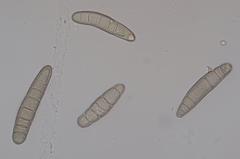 Bipolaris sorokinianae2pathogen
- Outcome
- metabolic activitye0
- Direction
- greateste0
- Value
- 170 %e0
- Qualifier
- between the 6th and the 24th he0
- Comparator
- control valuese0
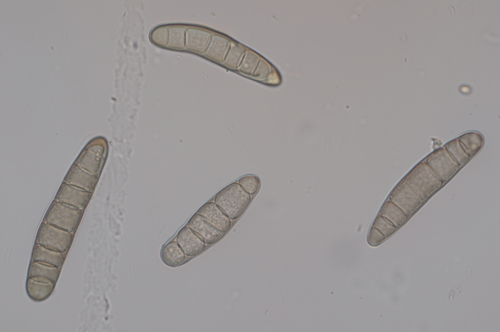
Organisms pictured · Representative pictures of the matched species, not figures from the paper.
Verbatim
e0“The greatest metabolic activity of fescue calli was observed between the 6th and the 24th h after treatment with phytotoxins and amounted to 170 % of control values”
e1“calli of spring barley and meadow fescue”
e2“Bipolaris sorokiniana”
Claim · model-written summary
Barley callus heat emission rose to 130–150% of control in the first 10 hours
- Taxon
- spring barley
 Hordeum vulgaree1
- Organ / stage
- callie0
- Treatment
- phytotoxinse3
- Interactor
- Bipolaris sorokinianaBipolaris sorokinianae2pathogen
- Outcome
- heat emissione0
- Direction
- increasede0
- Value
- 130–150 %e0
- Qualifier
- during the first 10 h of pathogenesise0
- Comparator
- control valuese0
Organisms pictured · Representative pictures of the matched species, not figures from the paper.

Verbatim
e0“In the case of barley calli, increased heat emission was registered during the first 10 h of pathogenesis (130–150 % of control values)”
e1“calli of spring barley and meadow fescue”
e2“Bipolaris sorokiniana”
e3“after treatment with phytotoxins”
Claim · model-written summary
Fescue phenolics fell to 40% of control after day 7
- Taxon
- meadow fescuee0
- Organ / stage
- tissuee0
- Treatment
- phytotoxinse2
- Interactor
- Bipolaris sorokinianaBipolaris sorokinianae1pathogen
- Outcome
- phenolic levele0
- Direction
- decreasee0
- Value
- 40 %e0
- Qualifier
- after the 7th day of experimente0
- Comparator
- controle0
Organisms pictured · Representative pictures of the matched species, not figures from the paper.
Verbatim
e0“In meadow fescue tissue a significant decrease in phenolic level in comparison with control (40 %) was observed after the 7th day of experiment”
e1“Bipolaris sorokiniana”
e2“after treatment with phytotoxins”
Claim · model-written summary
Barley callus total phenolics fell to 60–70% of control in the first 3 hours
- Taxon
- spring barleyHordeum vulgaree1
- Organ / stage
- callie0
- Treatment
- phytotoxinse3
- Interactor
- Bipolaris sorokinianaBipolaris sorokinianae2pathogen
- Outcome
- amount of total phenolicse0
- Direction
- decreasede0
- Value
- 60–70%e0
- Qualifier
- within the first 3 he0
- Comparator
- controle0
Organisms pictured · Representative pictures of the matched species, not figures from the paper.
Verbatim
e0“In barley calli the amount of total phenolics decreased within the first 3 h (60–70% of control)”
e1“calli of spring barley and meadow fescue”
e2“Bipolaris sorokiniana”
e3“after treatment with phytotoxins”
Claim · model-written summary
Barley and fescue differed in the rate of their metabolic and phenolic responses
- Taxon
- spring barleyHordeum vulgaree0
- Interactor
- B. sorokinianaBipolaris sorokinianae0pathogen
- Outcome
- rate of reactione0
- Comparator
- meadow fescuee0
Organisms pictured · Representative pictures of the matched species, not figures from the paper.
Verbatim
e0“spring barley and meadow fescue differ in the rate of reaction to B. sorokiniana phytotoxins with regard to changes in metabolic activity and phenolic content”
The same questions in other papers
pathogen product · Bipolaris sorokiniana · Hordeum vulgare (barley)Results agree
1 paper in the same direction as this paper
- negative
Claims are grouped by organism, treatment and what was measured or targeted. A paper counts as positive when any of its claims in the group is positive.