Abstract
The effects of Pyricularia oryzae, the causal agent of blast disease in rice, on plant growth, grain yield, and grain quality under Mediterranean conditions were studied in 2002 and 2003. Four rice varieties were grown under high and low disease pressure, achieved by early inoculation with the blast fungus and by natural infection, respectively. Results showed that inoculation affected the overall plant growth and yield and resulted in a reduction in plant height, number of productive tillers per plant, grain weight, and grain yield. The magnitude of the reduction was dependent on the varietals' susceptibility to the disease. Both types of the disease (leaf blast and neck blast) were negatively correlated with grain yield. It was estimated that each unit increase in leaf blast rating and neck blast resulted in 5.97 and 0.23 g plant^{-1} yield reduction, respectively. Grain quality traits were less affected by the disease treatments compared to the agronomic traits. The most pronounced effect of the disease was on total milling yield, which in some cases was reduced by inoculation up to 11%.
Abstract from the paper’s OpenAlex record, shown for indexing and research. Copyright remains with the authors or the publisher. Read at the source ↗
The text the model read, with the source record’s inline markup (italics, sub- and superscripts) rendered and its character entities decoded; quote offsets refer to the raw text.
Claims 7
Claim · model-written summary
Blast inoculation reduced plant height, productive tillers per plant and grain weight of rice relative to low disease pressure.
- Taxon
- rice
 Oryza sativae1
- Treatment
- inoculatione2
- Interactor
- Pyricularia oryzae
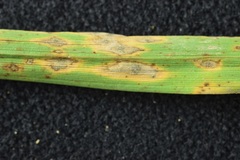 Pyricularia oryzaee1pathogen
- Outcome
- plant height, number of productive tillers per plant, grain weighte2
- Direction
- reductione2
- Comparator
- low disease pressuree3
- Setting
- Mediterranean conditionse1
Organisms pictured · Representative pictures of the matched species, not figures from the paper.

Verbatim
e1“The effects of Pyricularia oryzae, the causal agent of blast disease in rice, on plant growth, grain yield, and grain quality under Mediterranean conditions were studied in 2002 and 2003”
e2“Results showed that inoculation affected the overall plant growth and yield and resulted in a reduction in plant height, number of productive tillers per plant, grain weight, and grain yield”
e3“Four rice varieties were grown under high and low disease pressure, achieved by early inoculation with the blast fungus and by natural infection, respectively”
Claim · model-written summary
Blast inoculation reduced rice grain yield relative to low disease pressure.
- Taxon
- riceOryza sativae1
- Treatment
- inoculatione2
- Interactor
- Pyricularia oryzaePyricularia oryzaee1pathogen
- Outcome
- grain yielde2
- Direction
- reductione2
- Comparator
- low disease pressuree3
- Setting
- Mediterranean conditionse1
Organisms pictured · Representative pictures of the matched species, not figures from the paper.
Verbatim
e1“The effects of Pyricularia oryzae, the causal agent of blast disease in rice, on plant growth, grain yield, and grain quality under Mediterranean conditions were studied in 2002 and 2003”
e2“Results showed that inoculation affected the overall plant growth and yield and resulted in a reduction in plant height, number of productive tillers per plant, grain weight, and grain yield”
e3“Four rice varieties were grown under high and low disease pressure, achieved by early inoculation with the blast fungus and by natural infection, respectively”
Claim · model-written summary
Leaf blast and neck blast were both negatively correlated with rice grain yield.
- Taxon
- riceOryza sativae1
- Interactor
- Pyricularia oryzaePyricularia oryzaee1pathogen
- Outcome
- grain yielde4
- Direction
- negatively correlatede4
- Qualifier
- leaf blast and neck blaste4
Organisms pictured · Representative pictures of the matched species, not figures from the paper.
Verbatim
e1“The effects of Pyricularia oryzae, the causal agent of blast disease in rice, on plant growth, grain yield, and grain quality under Mediterranean conditions were studied in 2002 and 2003”
e4“Both types of the disease (leaf blast and neck blast) were negatively correlated with grain yield”
Claim · model-written summary
Each unit increase in leaf blast rating was estimated to reduce rice yield by 5.97 g per plant.
- Taxon
- riceOryza sativae1
- Interactor
- Pyricularia oryzaePyricularia oryzaee1pathogen
- Outcome
- yielde5
- Direction
- reductione5
- Value
- 5.97e5
- Qualifier
- each unit increase in leaf blast ratinge5
Organisms pictured · Representative pictures of the matched species, not figures from the paper.
Verbatim
e1“The effects of Pyricularia oryzae, the causal agent of blast disease in rice, on plant growth, grain yield, and grain quality under Mediterranean conditions were studied in 2002 and 2003”
e5“It was estimated that each unit increase in leaf blast rating and neck blast resulted in 5.97 and 0.23 g plant^{-1} yield reduction, respectively”
Claim · model-written summary
Each unit increase in neck blast rating was estimated to reduce rice yield by 0.23 g per plant.
- Taxon
- riceOryza sativae1
- Interactor
- Pyricularia oryzaePyricularia oryzaee1pathogen
- Outcome
- yielde5
- Direction
- reductione5
- Value
- 0.23e5
- Qualifier
- neck blaste5
Organisms pictured · Representative pictures of the matched species, not figures from the paper.
Verbatim
e1“The effects of Pyricularia oryzae, the causal agent of blast disease in rice, on plant growth, grain yield, and grain quality under Mediterranean conditions were studied in 2002 and 2003”
e5“It was estimated that each unit increase in leaf blast rating and neck blast resulted in 5.97 and 0.23 g plant^{-1} yield reduction, respectively”
Claim · model-written summary
Grain quality traits were less affected by the blast disease treatments than the agronomic traits.
- Taxon
- riceOryza sativae1
- Treatment
- disease treatmentse6
- Interactor
- Pyricularia oryzaePyricularia oryzaee1pathogen
- Outcome
- Grain quality traitse6
- Direction
- less affectede6
- Comparator
- agronomic traitse6
Organisms pictured · Representative pictures of the matched species, not figures from the paper.
Verbatim
e1“The effects of Pyricularia oryzae, the causal agent of blast disease in rice, on plant growth, grain yield, and grain quality under Mediterranean conditions were studied in 2002 and 2003”
e6“Grain quality traits were less affected by the disease treatments compared to the agronomic traits”
Claim · model-written summary
Inoculation reduced total milling yield of rice by up to 11% in some cases, the most pronounced effect of the disease.
- Taxon
- riceOryza sativae1
- Treatment
- inoculatione7
- Interactor
- Pyricularia oryzaePyricularia oryzaee1pathogen
- Outcome
- total milling yielde7
- Direction
- reducede7
- Value
- up to 11%e7
- Qualifier
- in some casese7
Not reportedComparator
Organisms pictured · Representative pictures of the matched species, not figures from the paper.
Verbatim
e1“The effects of Pyricularia oryzae, the causal agent of blast disease in rice, on plant growth, grain yield, and grain quality under Mediterranean conditions were studied in 2002 and 2003”
e7“The most pronounced effect of the disease was on total milling yield, which in some cases was reduced by inoculation up to 11%”
The same questions in other papers
inoculation · Pyricularia oryzae · Oryza sativa (rice)Positive and negative results
7 papers in the same direction as this paper · 9 in the opposite direction
- positive
- positive
- positive
13 papers more in this group
See all 17 papers →Claims are grouped by organism, treatment and what was measured or targeted. A paper counts as positive when any of its claims in the group is positive.