Abstract
Competition among plants often shifts from roots to shoots as productivity increases and species composition changes. We examined competition in an old field with low diversity to test whether this shift occurred along a productivity gradient without species turnover. Forty plots received one of four nitrogen treatments (0, 5, or 15 g added N m-2 yr-1 or 400 g m-2 yr-1 of sawdust added to immobilize N) annually for 5 yr. All N levels were dominated by the perennial grasses Agropyron cristatum and Bromus inermis. Transplants of Agropyron were grown with all neighbors, roots of neighbors, or no neighbors present to measure total, root, and shoot competition. Transplant growth was 22%-165% higher in subplots without neighbors present, which indicates that competition occurred. Competition from neighbor roots was primarily responsible for suppression of transplant growth over the entire productivity gradient. In contrast to previous field experiments that found either an increase in total competition intensity or a shift from root to shoot competition with increasing productivity, we found neither. Increases in total competition intensity or shifts from root to shoot competition found along other gradients may be caused by changes in species composition and not by increased resources or neighbor biomass. These results suggest that different competitive mechanisms may operate in low-diversity vegetation than in more diverse natural vegetation.
Abstract from the paper’s OpenAlex record, shown for indexing and research. Copyright remains with the authors or the publisher. Read at the source ↗
The text the model read, with the source record’s inline markup (italics, sub- and superscripts) rendered and its character entities decoded; quote offsets refer to the raw text.
Claims 4
Claim · model-written summary
Removing neighbors increased Agropyron transplant growth by 22%-165%.
 Agropyron
Not reportedComparator
Organisms pictured · Representative pictures of the matched species, not figures from the paper.

Verbatim
e0“Transplant growth was 22%-165% higher in subplots without neighbors present”
t0“the perennial grasses Agropyron cristatum and Bromus inermis”
Claim · model-written summary
Neighbor roots primarily suppressed Agropyron transplant growth across the productivity gradient.
Organisms pictured · Representative pictures of the matched species, not figures from the paper.
Verbatim
e0“Competition from neighbor roots was primarily responsible for suppression of transplant growth over the entire productivity gradient”
t0“the perennial grasses Agropyron cristatum and Bromus inermis”
Claim · model-written summary
Total competition intensity did not increase with productivity.
- Taxon
- Agropyron cristatum
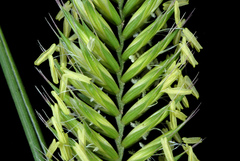 Agropyron cristatume1
- Outcome
- total competition intensitye0
- Setting
- productivity gradientt0
Not reportedDirection
Organisms pictured · Representative pictures of the matched species, not figures from the paper.

Verbatim
e0“In contrast to previous field experiments that found either an increase in total competition intensity or a shift from root to shoot competition with increasing productivity, we found neither”
t0“Productivity Gradient”
e1“the perennial grasses Agropyron cristatum and Bromus inermis”
Claim · model-written summary
Competition did not shift from roots to shoots with increasing productivity.
- Taxon
- Agropyron cristatumAgropyron cristatume1
- Organ / stage
- roote0
- Outcome
- root to shoot competitione0
Not reportedDirection
Organisms pictured · Representative pictures of the matched species, not figures from the paper.
Verbatim
e0“In contrast to previous field experiments that found either an increase in total competition intensity or a shift from root to shoot competition with increasing productivity, we found neither”
e1“the perennial grasses Agropyron cristatum and Bromus inermis”
The same questions in other papers
competition · growth · AgropyronResults agree
2 papers in the same direction as this paper
- positive
- positive
Claims are grouped by organism, treatment and what was measured or targeted. A paper counts as positive when any of its claims in the group is positive.