Abstract
This is the first North American report of Oidium longipes, an anamorphic powdery mildew species described recently in Europe. It was found on vegetatively propagated petunia grown in a commercial greenhouse in New Jersey, USA, where it caused a rapidly spreading disease. The pathogen might have originated offshore and may have already been distributed in the United States through horticultural trade. During field surveys in Europe, it was found on petunia in Hungary and Austria as well; this is the first report of O. longipes from these two countries. A detailed light microscopy study of American and European specimens of O. longipes, including freshly collected samples and authentic herbarium specimens, revealed that its conidiophore morphology is more variable than illustrated in the original species description or in subsequent works. Microcycle conidiation, a process not yet known to occur in powdery mildews, was repeatedly observed in O. longipes. The rDNA internal transcribed spacer (ITS) sequences were identical in colonies containing different conidiophore types as well as in a total of five specimens collected from petunia in the United States, Austria, Hungary, Germany, and Switzerland. A phylogenetic analysis of the ITS sequences revealed that the closest known relative of O. longipes is O. lycopersici, known to infect tomato only in Australia. Cross-inoculation tests showed that O. longipes from petunia heavily infected tobacco cv. Xanthi, while the tomato and eggplant cultivars tested were moderately susceptible to this pathogen. These results indicate that its spread represents a potential danger to a number of solanaceous crops. Our ad hoc field surveys conducted in 2006 and 2007 did not detect it outside New Jersey in the United States; all the other powdery mildew-infected petunias, collected in New York and Indiana, were infected by Podosphaera xanthii. In Europe, most of the powdery mildew-infected petunias examined in this study were infected by P. xanthii or Golovinomyces orontii. Our multiple inoculation tests revealed that the same petunia plants and even the same leaves can be infected concomitantly by O. longipes, O. neolycopersici, G. orontii, and P. xanthii. Thus, it is at present unclear to what extent O. longipes contributes to the powdery mildew epidemics that develop year after year on solanaceous plants in many parts of the world.
Abstract from the paper’s OpenAlex record; open copy licensed other-oa. Read at the source ↗
The text the model read, with the source record’s inline markup (italics, sub- and superscripts) rendered and its character entities decoded; quote offsets refer to the raw text.
Claims 8
Claim · model-written summary
Oidium longipes caused rapidly spreading disease on greenhouse petunia in New Jersey.
- Interactor
- Oidium longipes
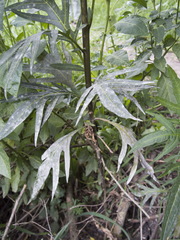 Golovinomyces longipest0pathogen
- Outcome
- rapidly spreading diseasee0
- Setting
- commercial greenhouse in New Jersey, USAe0
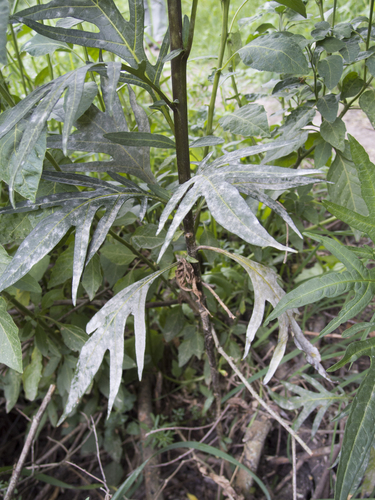
 Petunia
Organisms pictured · Representative pictures of the matched species, not figures from the paper.

Verbatim
e0“It was found on vegetatively propagated petunia grown in a commercial greenhouse in New Jersey, USA, where it caused a rapidly spreading disease”
t0“Oidium longipes”
Claim · model-written summary
Oidium longipes was found on petunia in Hungary and Austria.
- Interactor
- Oidium longipesGolovinomyces longipest0pathogen
- Outcome
- found on petuniae0
- Setting
- Hungary and Austriae0
Organisms pictured · Representative pictures of the matched species, not figures from the paper.
Verbatim
e0“it was found on petunia in Hungary and Austria as well”
t0“Oidium longipes”
Claim · model-written summary
Petunia-derived O. longipes heavily infected tobacco cv. Xanthi.
- Taxon
- tobacco
 Nicotiana tabacume0
- Material
- Xanthie0
- Interactor
- O. longipesGolovinomyces longipese0pathogen
- Outcome
- heavily infectede0
Organisms pictured · Representative pictures of the matched species, not figures from the paper.

Verbatim
e0“O. longipes from petunia heavily infected tobacco cv. Xanthi”
Claim · model-written summary
Tested tomato and eggplant cultivars were moderately susceptible to O. longipes.
- Taxon
- tomato and eggplant
 Solanum lycopersicum
 Solanum melongenae0
- Interactor
- Oidium longipesGolovinomyces longipest0pathogen
- Outcome
- moderately susceptiblee0
Organisms pictured · Representative pictures of the matched species, not figures from the paper.


Verbatim
e0“the tomato and eggplant cultivars tested were moderately susceptible to this pathogen”
t0“Oidium longipes”
Claim · model-written summary
Field surveys in 2006 and 2007 did not find O. longipes outside New Jersey in the United States.
- Interactor
- Oidium longipesGolovinomyces longipest0pathogen
- Outcome
- did not detect ite0
- Setting
- outside New Jersey in the United Statese0
Organisms pictured · Representative pictures of the matched species, not figures from the paper.
Verbatim
e0“field surveys conducted in 2006 and 2007 did not detect it outside New Jersey in the United States”
t0“Oidium longipes, A New Powdery Mildew Fungus on Petunia”
Claim · model-written summary
Powdery mildew on petunias from New York and Indiana was caused by Podosphaera xanthii.
- Interactor
- Podosphaera xanthii
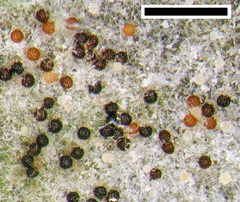 Podosphaera xanthiie0pathogen
- Outcome
- infectede0
- Setting
- New York and Indianae0
Organisms pictured · Representative pictures of the matched species, not figures from the paper.

Verbatim
e0“all the other powdery mildew-infected petunias, collected in New York and Indiana, were infected by Podosphaera xanthii”
Claim · model-written summary
Most examined European petunias with powdery mildew carried P. xanthii or Golovinomyces orontii.
- Interactor
- P. xanthiie0pathogen
- Second interactor
- Golovinomyces orontii
 Golovinomyces orontiie0pathogen
- Outcome
- infectede0
- Setting
- Europee0
Organisms pictured · Representative pictures of the matched species, not figures from the paper.

Verbatim
e0“In Europe, most of the powdery mildew-infected petunias examined in this study were infected by P. xanthii or Golovinomyces orontii”
Claim · model-written summary
One petunia plant or leaf could carry O. longipes, O. neolycopersici, G. orontii, and P. xanthii concurrently.
- Interactor
- O. longipesGolovinomyces longipese0pathogen
- Second interactor
- O. neolycopersiciErysiphe neolycopersicie0pathogen
- Outcome
- infected concomitantlye0
Organisms pictured · Representative pictures of the matched species, not figures from the paper.
Verbatim
e0“the same petunia plants and even the same leaves can be infected concomitantly by O. longipes, O. neolycopersici, G. orontii, and P. xanthii”