Abstract
Roles of H(2)O(2) in the infection process of Magnaporthe oryzae on rice were investigated. In a leaf sheath assay for up to 48 h post-inoculation, the absence or presence of catalase in the conidia suspension was correlated with the level of accumulated H(2)O(2) in infected leaf cells, as observed by staining with 3',3-diaminobenzidine tetrahydrochloride. In the incompatible interaction, the appearance of autofluorescence or frequency of cell death characterized by granulation (symptoms characteristic of hypersensitive responses) was not significantly affected by the presence of catalase in the conidia suspension. In the leaf blade assay, inoculation of compatible conidia in the presence of catalase produced more severe symptoms than that of conidia in the absence of catalase at 6 days post-inoculation. These results suggest that, in this host-parasite interaction, the primary role of host-produced H(2)O(2) is in limiting hyphal growth after penetration through toxic action. Furthermore, in incompatible interactions, H(2)O(2) is implied not to be a major mediator of hypersensitive cell death.
Abstract from the paper’s OpenAlex record, shown for indexing and research. Copyright remains with the authors or the publisher. Read at the source ↗
The text the model read, with the source record’s inline markup (italics, sub- and superscripts) rendered and its character entities decoded; quote offsets refer to the raw text.
Claims 5
Claim · model-written summary
Catalase presence in conidia suspension correlated with peroxide accumulation in infected rice leaf cells.
- Taxon
- rice
 Oryza sativat0
- Organ / stage
- leaf cellse0
- Treatment
- absence or presence of catalase in the conidia suspensione0
- Outcome
- level of accumulated H(2)O(2)e0
- Direction
- correlatede0
Organisms pictured · Representative pictures of the matched species, not figures from the paper.

Verbatim
e0“the absence or presence of catalase in the conidia suspension was correlated with the level of accumulated H(2)O(2) in infected leaf cells”
t0“H2O2 in rice cells”
Claim · model-written summary
Catalase did not significantly change autofluorescence or cell death in the incompatible interaction.
- Taxon
- riceOryza sativat0
- Treatment
- presence of catalase in the conidia suspensione0
- Outcome
- appearance of autofluorescence or frequency of cell deathe0
- Direction
- not significantly affectede0
Not reportedComparator
Organisms pictured · Representative pictures of the matched species, not figures from the paper.
Verbatim
e0“In the incompatible interaction, the appearance of autofluorescence or frequency of cell death characterized by granulation (symptoms characteristic of hypersensitive responses) was not significantly affected by the presence of catalase in the conidia suspension”
t0“H2O2 in rice cells”
Claim · model-written summary
Catalase with compatible conidia produced more severe rice leaf symptoms after six days than conidia without catalase.
- Taxon
- riceOryza sativat0
- Treatment
- inoculation of compatible conidia in the presence of catalasee0
- Interactor
- Magnaporthe oryzae
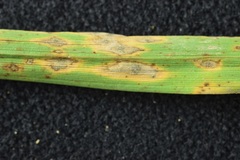 Pyricularia oryzaet1pathogen
- Outcome
- symptomse0
- Direction
- more severee0
- Qualifier
- 6 days post-inoculatione0
- Comparator
- conidia in the absence of catalasee0
Organisms pictured · Representative pictures of the matched species, not figures from the paper.
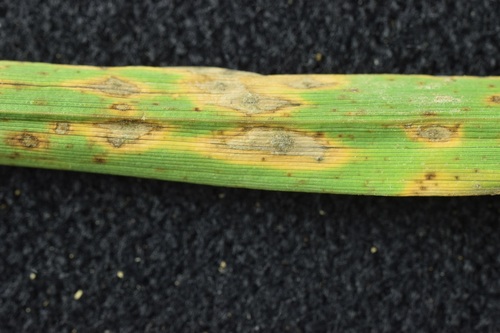
Verbatim
e0“inoculation of compatible conidia in the presence of catalase produced more severe symptoms than that of conidia in the absence of catalase at 6 days post-inoculation”
t0“H2O2 in rice cells”
t1“Magnaporthe oryzae”
Claim · model-written summary
The authors suggest host peroxide limits fungal hyphal growth after penetration through toxicity.
- Taxon
- riceOryza sativat0
- Interactor
- Magnaporthe oryzaePyricularia oryzaet1pathogen
- Compound
- H(2)O(2)e0
- Outcome
- hyphal growthe0
Organisms pictured · Representative pictures of the matched species, not figures from the paper.
Verbatim
e0“the primary role of host-produced H(2)O(2) is in limiting hyphal growth after penetration through toxic action”
t0“H2O2 in rice cells”
t1“Magnaporthe oryzae”
Claim · model-written summary
The authors infer peroxide is not a major mediator of hypersensitive cell death in incompatible interactions.
- Taxon
- riceOryza sativat0
- Interactor
- Magnaporthe oryzaePyricularia oryzaet1pathogen
- Compound
- H(2)O(2)e0
- Outcome
- hypersensitive cell deathe0
Organisms pictured · Representative pictures of the matched species, not figures from the paper.
Verbatim
e0“in incompatible interactions, H(2)O(2) is implied not to be a major mediator of hypersensitive cell death”
t0“H2O2 in rice cells”
t1“Magnaporthe oryzae”
The same questions in other papers
inoculation · Pyricularia oryzae · Oryza sativa (rice)Positive and negative results
7 papers in the same direction as this paper · 9 in the opposite direction
- positive
- positive
- positive
13 papers more in this group
See all 17 papers →Claims are grouped by organism, treatment and what was measured or targeted. A paper counts as positive when any of its claims in the group is positive.