Abstract
The progress of nonpersistently transmitted virus epidemics can be substantially altered by the degree of aphid attraction and preference for virus-infected plants. Our objective was to determine whether color or odor-mediated cues of plants infected with Potyviridae mediate aphid attraction. We found that Myzus persicae (Sulzer) and Rhopalosiphum maidis (Fitch) preferred alighting on intensely (highly saturated) yellow than on green (plant-like) or brown (soil-like) ceramic tiles, and expressed no preference for landing on leaves infected with soybean mosaic virus (SMV) or on chlorophyll-deficient soybean leaves. Furthermore, neither aphid species showed odor-mediated attraction to leaf extracts of SMV-infected leaves. Also, R. maidis remained longer on uninfected than on SMV-infected soybean plants before taking flight, although M. periscae exhibited no preference. Neither aphid species had a preference to remain on healthy or potato virus Y-infected plants. Therefore, we conclude that both aphid species when landing are equally likely to alight on healthy or SMV-infected soybean plants in the field, but R. maidis is likely to remain a shorter time on SMV-infected than on healthy plants before taking off. The fact that aphids leave the infected plant soon after probing increases the probability of finding another plant and making an infective probe before the vector loses its potential to inoculate the virus. These results could be used to increase the precision of existing simulations models, such as the one previously developed for SMV.
Abstract from the paper’s OpenAlex record, shown for indexing and research. Copyright remains with the authors or the publisher. Read at the source ↗
The text the model read, with the source record’s inline markup (italics, sub- and superscripts) rendered and its character entities decoded; quote offsets refer to the raw text.
Claims 7
Claim · model-written summary
Myzus persicae and Rhopalosiphum maidis preferred alighting on intensely yellow over green or brown ceramic tiles.
- Taxon
- Myzus persicae (Sulzer) and Rhopalosiphum maidis (Fitch)
 Myzus persicae
 Rhopalosiphum maidise0
- Outcome
- preferred alightinge0
- Direction
- preferrede0
- Comparator
- green (plant-like) or brown (soil-like) ceramic tilese0
- Setting
- ceramic tilese0
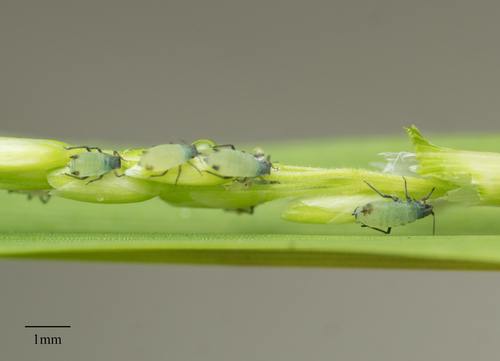
Organisms pictured · Representative pictures of the matched species, not figures from the paper.

Verbatim
e0“We found that Myzus persicae (Sulzer) and Rhopalosiphum maidis (Fitch) preferred alighting on intensely (highly saturated) yellow than on green (plant-like) or brown (soil-like) ceramic tiles”
Claim · model-written summary
The two aphid species expressed no preference for landing on SMV-infected leaves or on chlorophyll-deficient soybean leaves.
- Taxon
- soybean
 Glycine maxe0
- Interactor
- Myzus persicae (Sulzer) and Rhopalosiphum maidis (Fitch)Myzus persicaeRhopalosiphum maidise1pest
- Second interactor
- soybean mosaic virus
 Soybean mosaic viruse0pathogen
- Outcome
- no preference for landinge0
Organisms pictured · Representative pictures of the matched species, not figures from the paper.


Verbatim
e0“expressed no preference for landing on leaves infected with soybean mosaic virus (SMV) or on chlorophyll-deficient soybean leaves”
e1“Myzus persicae (Sulzer) and Rhopalosiphum maidis (Fitch)”
Claim · model-written summary
Neither aphid species showed odor-mediated attraction to leaf extracts of SMV-infected leaves.
Verbatim
e0“neither aphid species showed odor-mediated attraction to leaf extracts of SMV-infected leaves”
Claim · model-written summary
R. maidis remained longer on uninfected than on SMV-infected soybean plants before taking flight.
- Taxon
- soybeanGlycine maxe0
- Interactor
- R. maidisRhopalosiphum maidise0pest
- Second interactor
- SMVe0pathogen
- Outcome
- before taking flighte0
- Direction
- longere0
- Comparator
- uninfectede0
Organisms pictured · Representative pictures of the matched species, not figures from the paper.
Verbatim
e0“R. maidis remained longer on uninfected than on SMV-infected soybean plants before taking flight”
Claim · model-written summary
M. persicae (written M. periscae) exhibited no preference in how long it remained on SMV-infected versus uninfected soybean plants.
Verbatim
e0“although M. periscae exhibited no preference”
Claim · model-written summary
Neither aphid species had a preference to remain on healthy or potato virus Y-infected plants.
- Taxon
- aphide0
- Interactor
- aphide0pest
- Second interactor
- potato virus Y
 Potato virus Ye0pathogen
- Outcome
- preference to remaine0
- Comparator
- healthye0
Organisms pictured · Representative pictures of the matched species, not figures from the paper.

Verbatim
e0“Neither aphid species had a preference to remain on healthy or potato virus Y-infected plants”
Claim · model-written summary
Aphids leaving an infected plant soon after probing increases the probability of finding another plant and making an infective probe before the vector loses its potential to inoculate the virus.
- Taxon
- aphidsAphidomorphae0
- Interactor
- aphidsAphidomorphae0pest
- Outcome
- probability of finding another plant and making an infective probee0
- Qualifier
- leave the infected plant soon after probinge0
Verbatim
e0“The fact that aphids leave the infected plant soon after probing increases the probability of finding another plant and making an infective probe before the vector loses its potential to inoculate the virus”