Abstract
An investigation of the recruit, survivorship and growth of naturally regenerating tree species on canal bank was conducted to select tree species which are suitable for preceding planting in drained and burnt peat swamp lands in Central Kalimantan, Indonesia. Top of the canal bank were open, with greater soil moisture deficit and higher soil temperatures than on the next intact forest floor. The abundant trees were asam-asam ( Ploiarium alternifolium ) , garunggang ( C ra to xylon arborescens ) and tumih ( C o mbretocarpus rotundatus ) . New regeneration of these trees on the canal bank was confirmed during this investigation and mortality was very low. These results indicated that P. alternifolium,C. a rb o resc e ns and C. rot u nd at us were tolerant of intensive radiation, soil drought and high soil temperatures during germination. The annual height increments were 189-232 cm y -1 ( P. alternifolium ), 118-289 cm y -1 (C. a r bo r e s c e n s ) and 27-255 cm y -1 ( C. rot u nd at us ); thus, these three species could be classified as fast-growing with tolerance to open and dry conditions. Such characteristics were important to avoid competition with herbs, ferns,and/ or climbers. The results·suggest that P. alternifolium , C. a r bo r e s c e n s and C. ro t un d a t us are suitable for preceding planting for the rehabilitation of the disturbed peat swamp forests of Central Kalimantan.
Abstract from the paper’s OpenAlex record; open copy licensed cc-by-nc-sa. Read at the source ↗
The text the model read, with the source record’s inline markup (italics, sub- and superscripts) rendered and its character entities decoded; quote offsets refer to the raw text.
Claims 9
Claim · model-written summary
Three tree species were tolerant of intensive radiation, soil drought and high soil temperatures during germination.
- Taxon
- P. alternifolium,C. a rb o resc e ns and C. rot u nd at use1
- Outcome
- tolerant of intensive radiation, soil drought and high soil temperatures during germinatione1
Not reportedDirection
Verbatim
e1“These results indicated that P. alternifolium,C. a rb o resc e ns and C. rot u nd at us were tolerant of intensive radiation, soil drought and high soil temperatures during germination”
Claim · model-written summary
New regeneration of the three tree species on the canal bank was confirmed.
- Taxon
- P. alternifolium,C. a rb o resc e ns and C. rot u nd at use1
- Outcome
- New regeneratione2
- Setting
- on the canal banke2
Not reportedDirection
Verbatim
e1“These results indicated that P. alternifolium,C. a rb o resc e ns and C. rot u nd at us were tolerant of intensive radiation, soil drought and high soil temperatures during germination”
e2“New regeneration of these trees on the canal bank was confirmed during this investigation”
Claim · model-written summary
Mortality of the three tree species on the canal bank was very low.
Verbatim
e1“These results indicated that P. alternifolium,C. a rb o resc e ns and C. rot u nd at us were tolerant of intensive radiation, soil drought and high soil temperatures during germination”
e3“mortality was very low”
Claim · model-written summary
Ploiarium alternifolium had an annual height increment of 189-232 cm per year.
- Taxon
- P. alternifolium
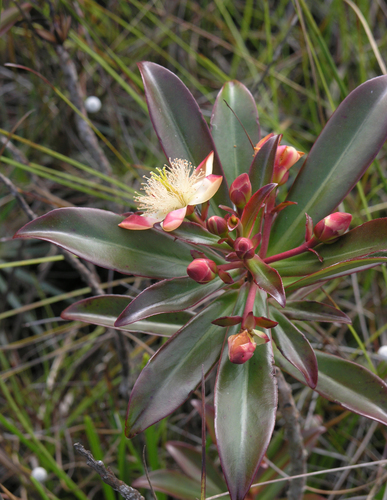
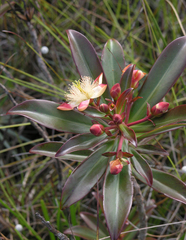 Ploiarium eleganse4
- Outcome
- annual height incrementse4
- Value
- 189-232 cm y -1e4
Organisms pictured · Representative pictures of the matched species, not figures from the paper.
Verbatim
e4“The annual height increments were 189-232 cm y -1 ( P. alternifolium )”
Claim · model-written summary
Cratoxylon arborescens had an annual height increment of 118-289 cm per year.
Verbatim
e4“The annual height increments were 189-232 cm y -1 ( P. alternifolium )”
e5“118-289 cm y -1 (C. a r bo r e s c e n s )”
Claim · model-written summary
Combretocarpus rotundatus had an annual height increment of 27-255 cm per year.
Verbatim
e4“The annual height increments were 189-232 cm y -1 ( P. alternifolium )”
e6“27-255 cm y -1 ( C. rot u nd at us )”
Claim · model-written summary
The three species could be classified as fast-growing with tolerance to open and dry conditions.
- Taxon
- P. alternifolium,C. a rb o resc e ns and C. rot u nd at use1
- Outcome
- fast-growing with tolerance to open and dry conditionse7
Not reportedDirection
Verbatim
e1“These results indicated that P. alternifolium,C. a rb o resc e ns and C. rot u nd at us were tolerant of intensive radiation, soil drought and high soil temperatures during germination”
e7“these three species could be classified as fast-growing with tolerance to open and dry conditions”
Claim · model-written summary
The authors recommend the three species for preceding planting in the rehabilitation of disturbed peat swamp forests of Central Kalimantan.
Verbatim
e1“P. alternifolium , C. a r bo r e s c e n s and C. ro t un d a t us are suitable for preceding planting”
e0“are suitable for preceding planting for the rehabilitation of the disturbed peat swamp forests of Central Kalimantan”
Claim · model-written summary
The canal bank had greater soil moisture deficit and higher soil temperatures than the next intact forest floor.
Verbatim
e1“These results indicated that P. alternifolium,C. a rb o resc e ns and C. rot u nd at us were tolerant of intensive radiation, soil drought and high soil temperatures during germination”
e2“with greater soil moisture deficit and higher soil temperatures than on the next intact forest floor”