Claim · model-written summary
AcfR has a phosphorylatable REC domain and a LuxR DNA binding domain.
- Taxon
- A. caulinodans ORS571
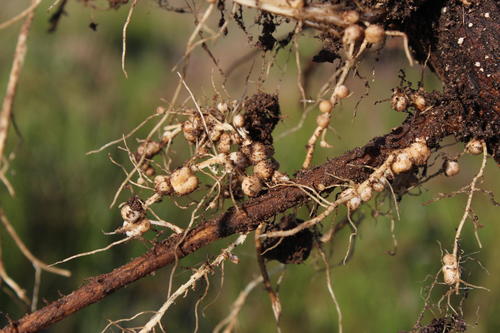
 Azorhizobium caulinodanse0
- Gene
- AcfRe0
- Outcome
- phosphorylatable N-terminal REC (receiver) domaine0
Verbatim
e0“AcfR, with a phosphorylatable N-terminal REC (receiver) domain and a C-terminal HTH (helix-turn-helix) LuxR DNA-binding domain in A. caulinodans ORS571”
Title
FixJ family regulator AcfR of Azorhizobium caulinodans is involved in symbiosis with the host plant
Wei Liu; Xue Bai; Yan Li; et al. BMC Microbiology 2021. doi:10.1186/s12866-021-02138-w
Other claims from this paper (6)
- Observation AcfR is phylogenetically close to NarL/FixJ regulators.
- Observation Six histidine kinases were predicted to interact with AcfR.
- Observation The ΔacfR mutant had significantly reduced free-living motility.
- Observation The ΔacfR mutant had significantly reduced free-living exopolysaccharide production.
- Observation The ΔacfR mutant was competitively defective in nodulation of host stems and roots.
- Mechanism AcfR is interpreted to give A. caulinodans competitive ability for symbiotic nodulation.