Azorhizobium 12 claims

genus · family Xanthobacteraceae · bacterium · NCBI Taxonomy ↗

2 spellings

Azorhizobium
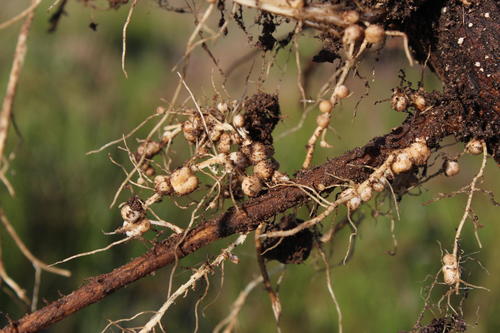
AzorhizobiumTony Rebelo · CC BY-SA 4.0 · iNaturalist ↗
Observationobservedoriginal resultmeasured

Claim · model-written summary

No hybridization signal was found in the other listed genera.

Taxon
Mesorhizobium, Bradyrhizo-bium, Azorhizobium, and AgrobacteriumAzorhizobiumAgrobacteriumBradyrhizobiumMesorhizobiume0
Outcome
no hybridization signale0

Verbatim

e0

“no hybridization signal was detected in species from the Mesorhizobium, Bradyrhizo-bium, Azorhizobium, and Agrobacterium genera”

✓ located verbatim in the source · abstract, characters 424–551

Title

Conservation of noIR in the Sinorhizobium and Rhizobium Genera of the Rhizobiaceae Family

Ernö Kiss; Peter Mergaert; Boglàrka Olàh; et al. Molecular Plant-Microbe Interactions 1998. doi:10.1094/mpmi.1998.11.12.1186

Other claims from this paper (6)
Intervention effectobservedoriginal resultnegativemeasured

Claim · model-written summary

The cytbd single mutant fixed nitrogen at 70 to 90% of wild-type rates under 2% oxygen.

Taxon
AzorhizobiumAzorhizobiume0
Treatment
cytbd-e0
Outcome
fixed N2e0
Direction
lowerinferrede0
Value
70 to 90%e0
Qualifier
2% O2 atmospheree0
Comparator
wild-typee0

Verbatim

e0

“In aerobic culture under 2% O2 atmosphere, Azorhizobium cytbd- and cytcbb3- single mutants both fixed N2 at 70 to 90% of wild-type rates”

✓ located verbatim in the source · abstract, characters 485–621

Title

Azorhizobium caulinodans uses both cytochrome bd (quinol) and cytochrome cbb3 (cytochrome c) terminal oxidases for symbiotic N2 fixation

P A Kaminski; C L Kitts; Z Zimmerman; et al. Journal of Bacteriology 1996. doi:10.1128/jb.178.20.5989-5994.1996

schema checkedfield values found in the cited quotesPermalinkReport an issue

Other claims from this paper (11)
Intervention effectobservedoriginal resultnegativemeasured

Claim · model-written summary

The cytcbb3 single mutant fixed nitrogen at 70 to 90% of wild-type rates under 2% oxygen.

Taxon
AzorhizobiumAzorhizobiume0
Treatment
cytcbb3-e0
Outcome
fixed N2e0
Direction
lowerinferrede0
Value
70 to 90%e0
Comparator
wild-typee0

Verbatim

e0

“In aerobic culture under 2% O2 atmosphere, Azorhizobium cytbd- and cytcbb3- single mutants both fixed N2 at 70 to 90% of wild-type rates”

✓ located verbatim in the source · abstract, characters 485–621

Title

Azorhizobium caulinodans uses both cytochrome bd (quinol) and cytochrome cbb3 (cytochrome c) terminal oxidases for symbiotic N2 fixation

P A Kaminski; C L Kitts; Z Zimmerman; et al. Journal of Bacteriology 1996. doi:10.1128/jb.178.20.5989-5994.1996

schema checkedfield values found in the cited quotesPermalinkReport an issue

Other claims from this paper (11)
Intervention effectobservedoriginal resultnegativemeasured

Claim · model-written summary

Double mutants completely lacked symbiotic nitrogen fixation.

Taxon
AzorhizobiumAzorhizobiume0
Treatment
cytbd- cytcbb3-double mutantse0
Interactor
Sesbania rostrataSesbania rostratae1host
Outcome
symbiotic N2 fixation activitye0
Direction
completely lackede0

Not reportedComparator

Verbatim

e0

“Azorhizobium cytbd- cytcbb3-double mutants, which carry both null alleles, completely lacked symbiotic N2 fixation activity.”

✓ located verbatim in the source · abstract, characters 718–842
e1

“Sesbania rostrata symbiotic nodules”

✓ located verbatim in the source · abstract, characters 1747–1782

Title

Azorhizobium caulinodans uses both cytochrome bd (quinol) and cytochrome cbb3 (cytochrome c) terminal oxidases for symbiotic N2 fixation

P A Kaminski; C L Kitts; Z Zimmerman; et al. Journal of Bacteriology 1996. doi:10.1128/jb.178.20.5989-5994.1996

Other claims from this paper (11)
Mechanismauthor interpretationoriginal resultmeasured

Claim · model-written summary

Both oxidases drive respiration during symbiotic nitrogen fixation at nanomolar oxygen.

Taxon
AzorhizobiumAzorhizobiume0
Interactor
Sesbania rostrataSesbania rostratae1host
Gene
cytbd and cytcbb3 oxidasese0
Outcome
respiratione0

Verbatim

e0

“both Azorhizobium cytbd and cytcbb3 oxidases drive respiration in environments with nanomolar O2 concentrations during symbiotic N2 fixation.”

✓ located verbatim in the source · abstract, characters 854–995
e1

“Sesbania rostrata symbiotic nodules”

✓ located verbatim in the source · abstract, characters 1747–1782

Title

Azorhizobium caulinodans uses both cytochrome bd (quinol) and cytochrome cbb3 (cytochrome c) terminal oxidases for symbiotic N2 fixation

P A Kaminski; C L Kitts; Z Zimmerman; et al. Journal of Bacteriology 1996. doi:10.1128/jb.178.20.5989-5994.1996

Other claims from this paper (11)
Intervention effectobservedoriginal resultnegativemeasured

Claim · model-written summary

Double mutants fixed nitrogen at 70% of wild-type rates in culture under 2% oxygen.

Taxon
AzorhizobiumAzorhizobiume0
Treatment
cytbd- cytcbb3- double mutantse0
Outcome
fixed N2e0
Direction
lowerinferrede0
Value
70%e0
Comparator
wild-typee0

Verbatim

e0

“In culture under a 2% O2 atmosphere, Azorhizobium cytbd- cytcbb3- double mutants fixed N2 at 70% of wild-type rates”

✓ located verbatim in the source · abstract, characters 996–1111

Title

Azorhizobium caulinodans uses both cytochrome bd (quinol) and cytochrome cbb3 (cytochrome c) terminal oxidases for symbiotic N2 fixation

P A Kaminski; C L Kitts; Z Zimmerman; et al. Journal of Bacteriology 1996. doi:10.1128/jb.178.20.5989-5994.1996

schema checkedfield values found in the cited quotesPermalinkReport an issue

Other claims from this paper (11)
Mechanismhypothesisoriginal resultmeasured

Claim · model-written summary

Residual nitrogen fixation presumably reflects other terminal oxidase activities.

Taxon
AzorhizobiumAzorhizobiume0
Gene
cytaa3 and cytboe0
Outcome
fixed N2e0
Qualifier
presumablye0

Verbatim

e0

“Azorhizobium cytbd- cytcbb3- double mutants fixed N2 at 70% of wild-type rates, presumably reflecting cytaa3 and cytbo (and other) terminal oxidase activities.”

✓ located verbatim in the source · abstract, characters 1033–1192

Title

Azorhizobium caulinodans uses both cytochrome bd (quinol) and cytochrome cbb3 (cytochrome c) terminal oxidases for symbiotic N2 fixation

P A Kaminski; C L Kitts; Z Zimmerman; et al. Journal of Bacteriology 1996. doi:10.1128/jb.178.20.5989-5994.1996

schema checkedfield values found in the cited quotesPermalinkReport an issue

Other claims from this paper (11)
Observationobservedoriginal resultmeasured

Claim · model-written summary

cytbd oxidase maintained dissolved oxygen at 3.6 microM.

Taxon
AzorhizobiumAzorhizobiume0
Gene
cytbd oxidasee0
Outcome
dissolved O2e0
Direction
maintainede0
Value
3.6 microMe0

Verbatim

e0

“Azorhizobium cytbd- and cytcbb3- single mutants were compared for their ability to deplete a limiting-O2 sparge; cytbd oxidase activity maintained dissolved O2 at 3.6 microM steady state”

✓ located verbatim in the source · abstract, characters 1245–1431

Title

Azorhizobium caulinodans uses both cytochrome bd (quinol) and cytochrome cbb3 (cytochrome c) terminal oxidases for symbiotic N2 fixation

P A Kaminski; C L Kitts; Z Zimmerman; et al. Journal of Bacteriology 1996. doi:10.1128/jb.178.20.5989-5994.1996

schema checkedfield values found in the cited quotesPermalinkReport an issue

Other claims from this paper (11)
Observationobservedoriginal resultmeasured

Claim · model-written summary

cytbd oxidase was inactive below 3.6 microM dissolved oxygen in oxygen-limited culture.

Taxon
AzorhizobiumAzorhizobiume0
Gene
cytbd oxidasee0
Outcome
inactivee0
Qualifier
below 3.6 microM dissolved O2e0

Verbatim

e0

“in O2 limited continuous culture, Azorhizobium cytbd oxidase is inactive below 3.6 microM dissolved O2”

✓ located verbatim in the source · abstract, characters 1633–1735

Title

Azorhizobium caulinodans uses both cytochrome bd (quinol) and cytochrome cbb3 (cytochrome c) terminal oxidases for symbiotic N2 fixation

P A Kaminski; C L Kitts; Z Zimmerman; et al. Journal of Bacteriology 1996. doi:10.1128/jb.178.20.5989-5994.1996

schema checkedfield values found in the cited quotesPermalinkReport an issue

Other claims from this paper (11)
Mechanismauthor interpretationoriginal resultmeasured

Claim · model-written summary

Both oxidases seem to contribute equally in Sesbania nodules at 10 to 20 nM oxygen.

Taxon
AzorhizobiumAzorhizobiume0
Interactor
Sesbania rostrataSesbania rostratae0host
Gene
cytbd and cytcbb3e0
Outcome
contribute equally as respiratory terminal oxidasese0
Qualifier
10 to 20 nMe0

Verbatim

e0

“in Sesbania rostrata symbiotic nodules, in which physiological, dissolved O2 is maintained at 10 to 20 nM, both Azorhizobium cytbd and cytcbb3 seem to contribute equally as respiratory terminal oxidases.”

✓ located verbatim in the source · abstract, characters 1744–1947

Title

Azorhizobium caulinodans uses both cytochrome bd (quinol) and cytochrome cbb3 (cytochrome c) terminal oxidases for symbiotic N2 fixation

P A Kaminski; C L Kitts; Z Zimmerman; et al. Journal of Bacteriology 1996. doi:10.1128/jb.178.20.5989-5994.1996

Other claims from this paper (11)